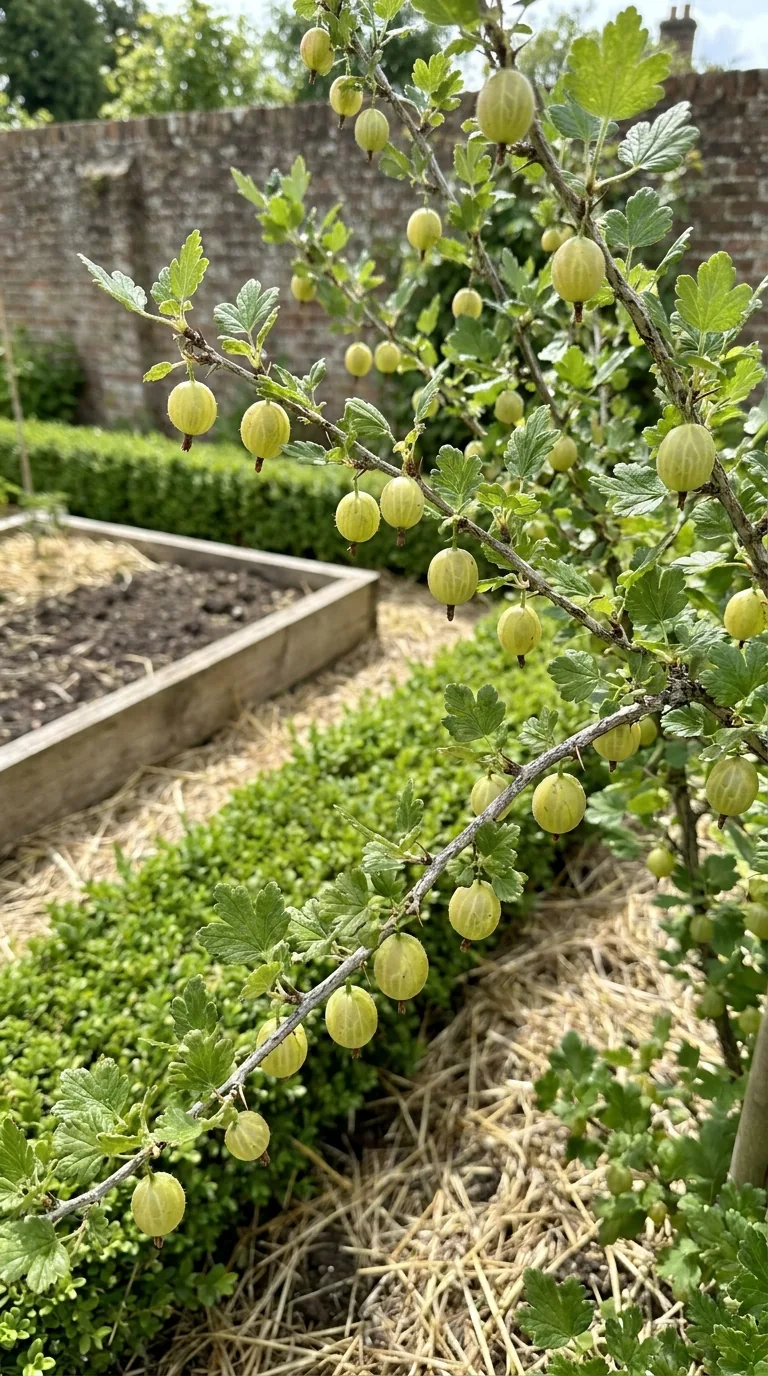
Gooseberries are useful British garden fruit because they are hardy, relatively compact and available in flavours and colours rarely found on supermarket shelves. A bush can provide fruit for cooking and, with a suitable dessert cultivar, sweet ripe berries for eating fresh. The crop is easier to manage when the branch framework stays open and you can reach through it without forcing your hands into a dense tangle of thorns.
Start with a healthy plant, moist but well-drained ground and enough space for its mature spread. Annual pruning maintains access and useful fruiting wood, while regular leaf checks help spot sawfly larvae before they remove much foliage. These are straightforward tasks when done a little at a time. A neglected bush can still be renewed, but heavy cutting may temporarily reduce the crop.
Choose fruit and plant form deliberately
Gooseberry cultivars differ in colour, flavour, thorniness and susceptibility to mildew. Culinary types are useful for pies, sauces and preserves, while dessert types develop sweetness when allowed to ripen fully. Some are dual purpose. A green berry picked early for cooking and a fully ripe dessert berry are different products, so decide what you want before judging whether a cultivar tastes too sharp.
Red and yellow fruits can be attractive as well as useful, but colour alone does not indicate sweetness. Read the cultivar description and ask about local performance. A less thorny selection may make picking easier, while mildew resistance is helpful where the disease is a recurring problem. Resistance reduces susceptibility; it does not mean the plant can never develop symptoms.
The simplest form is a free-standing bush. Cordons use a narrow vertical framework and can fit a smaller space, while fans occupy a wall or wire support. Standards have a raised head and normally need permanent support. Choose a form you are willing to maintain. A trained plant is not automatically low maintenance merely because it occupies little ground area.
Find a position with light and airflow
Gooseberries grow in sun or light shade. A sunny position generally supports sweeter, better-ripened fruit, while light shade can be useful where summer heat and drying are concerns. Deep shade limits performance. Avoid a location where taller shrubs completely cover the gooseberry in summer or make it difficult to inspect the lower leaves.
Choose moist, well-drained soil rather than a place that stays waterlogged in winter. The roots need access to both water and air. A sheltered position reduces the risk of brittle branches breaking, especially when they carry fruit, but leave enough airflow around the bush. A narrow damp corner packed with plants is less convenient for both disease monitoring and picking.
Avoid an obvious frost pocket where possible. The shrub may tolerate winter cold while open flowers remain vulnerable to a late frost. Temporary cover can reduce exposure when a damaging night is forecast, but it cannot guarantee fruit set. Remove or open protection appropriately during the day so flowers remain accessible to pollinating insects.
Prepare and plant at the original depth
Bare-root plants are available during dormancy and can be planted from late autumn into early spring when the soil is workable. Container-grown plants offer a wider window, but avoid frozen, waterlogged or very dry conditions. Keep bare roots moist before planting and follow the supplier's handling instructions. Delaying in an unsuitable warm room can be more damaging than waiting briefly in an appropriate sheltered holding arrangement.
Clear perennial weeds and improve poor soil with suitable well-rotted organic matter. Make a hole broad enough to spread the roots or accommodate the rootball. Position the plant at the same depth it previously grew: use the soil mark on bare-root stems or the top of the container compost as a guide. Do not bury the base deeply in an attempt to make it sturdier.
Backfill, firm gently and water to settle the soil. Bushes commonly need about 1.2–1.5m between plants, adjusted for cultivar and access, while cordons can be much closer because their framework is deliberately restricted. Confirm spacing for the particular form. A small nursery bush soon becomes difficult to reach if planted immediately beside another spiny shrub.
Set up container-grown gooseberries carefully
Choose a generous pot, commonly at least around 40cm wide and deep, with open drainage holes. A compact cultivar or trained form is easier to manage than a vigorous bush in an undersized container. Use a suitable peat-free, soil-based compost for long-term fruit bushes. A shallow decorative bowl is unlikely to give stable moisture or sufficient root space for repeated cropping.
Plant at the original level and leave a watering gap below the rim. Stand the pot where drainage holes remain clear and the full container is stable in wind. A standard or cordon needs its own reliable support. Do not assume the weight of a small pot will stabilise a tall head of foliage and fruit on an exposed balcony.
Plan future maintenance. Container roots eventually become crowded and compost loses structure, so repotting or suitable root maintenance will be needed. In intervening years, refresh the surface carefully without damaging shallow roots or burying the stem. Keep the pot accessible from more than one side so pruning, leaf inspection and harvesting do not become awkward.
Water according to establishment and root space
Newly planted gooseberries need watering during dry spells while roots establish, particularly through their first couple of seasons. Apply water to the root zone and allow it to soak in. An established bush in suitable ground may need little additional watering outside prolonged dry weather. Watch fruit development and soil conditions rather than treating hardiness as proof that no water is required.
Container plants need regular moisture checks throughout active growth. Feel below the surface, water before the rootball becomes repeatedly dry and allow surplus to drain. A pot beneath dense foliage or beside a wall may receive surprisingly little rain. Conversely, an outdoor pot in wet weather may need no extra water even if you normally check it every day.
Avoid leaving the roots permanently in a water-filled saucer. A wilted plant over wet compost needs investigation rather than another automatic watering. Check drainage holes, the outer pot and root condition. Severe drying and prolonged saturation can both damage roots and reduce performance, but they call for different corrective actions.
Mulch and feed without forcing soft growth
Mulch established ground-grown bushes in spring with suitable well-rotted organic matter while the soil is moist. This helps reduce evaporation and makes weeds easier to manage. Leave a small clear circle around the stem base so damp material does not sit against the bark. Do not add a thick mulch over dry soil and assume it has supplied the missing water.
A healthy bush in regularly improved soil may need no supplementary feeding. If soil is poor or a deficiency is identified, apply an appropriate fertiliser at its label rate. Avoid high nitrogen doses intended simply to make the plant grow faster. Soft, lush growth can be more susceptible to problems such as mildew and can make an already crowded bush harder to maintain.
Potted plants depend more directly on supplied nutrients. A suitable high-potassium feed during the growing season can support fruiting, used according to the product instructions and the compost's existing nutrient content. Do not combine several fertilisers without accounting for their total contribution. Record applications if more than one person maintains the containers.
Prune for an open, reachable framework
An open-centred bush allows light and air into the branches and gives your hand a route to the fruit. Begin by removing dead, damaged, diseased and crossing branches. Look at the framework before shortening every shoot. Some healthy outward-facing branches should remain to carry fruit; the objective is a balanced plant, not a hollow shell with all useful wood removed.
Pruning systems vary. Established bushes can be managed through branch renewal in winter, or through a more detailed spur-pruning routine in winter and summer. Choose one suitable method and follow it consistently rather than combining every instruction you encounter. A trained cordon has different priorities from a free-standing bush because its main framework must remain restricted.
For a straightforward winter tidy, work while dormant and the branches are visible. Remove low branches that lie on the ground and selected older congested growth, keeping a useful balance of younger wood. Cut cleanly to an appropriate outward-facing bud or branch junction. Wear gloves and protect your eyes when working among thorny branches.
If using spur pruning, summer shortening of selected new side shoots can help keep the structure accessible, followed by the appropriate winter cuts. Do not cut the main framework and every new shoot to identical stubs without knowing which growth the system intends to retain. If uncertain, make the obvious sanitation and crossing-branch cuts first and seek guidance for the remaining form.
Understand cordons and standards before cutting
A cordon has one principal stem supported vertically or at an angle, with short fruiting side growth. Its pruning maintains that structure and height rather than opening a many-branched bush. Keep the leader tied securely and adjust ties as it thickens. Remove competing growth that would turn it into an unrestricted bush, following the training plan supplied with the plant.
A standard has a head raised on a stem and is generally easiest to buy already trained. Maintain its permanent stake and check ties regularly. Remove unwanted shoots from the clear trunk or below a graft as appropriate, while pruning the head for a balanced open shape. A heavily laden or windblown head places leverage on the stem, so support is part of long-term care.
If a trained plant has lost its shape, identify the main structure before making large cuts. Renovation may need several seasons and can reduce the immediate harvest. A few photographs from different angles help you plan. Do not expect one severe pruning session to restore both perfect shape and a full crop immediately.
Check for gooseberry sawfly early
Sawfly larvae can remove leaves quickly, so inspect the bush during spring and summer rather than waiting for the whole plant to look bare. Look at the lower and inner foliage as well as the obvious outer tips. The larvae are caterpillar-like, and some species have green bodies with dark spotting. Several species can feed on gooseberries, so appearance and timing vary.
Fresh holes, skeletonised leaves and groups of larvae are reasons for a closer inspection. Hand removal can be effective on a small bush when the infestation is found early. Put a tray beneath the branch if helpful and check again after a few days. Removing one visible group does not prove the problem is finished for the season, because further generations or overlooked larvae may occur.
Do not treat every caterpillar-like animal as the same pest. Confirm identification, especially before selecting a product. Sawflies are not butterfly or moth caterpillars, and a control intended for one group may not work on the other. Use only currently authorised products appropriate for gooseberries and the identified problem, following the label and any harvest interval exactly.
Distinguish mildew and other setbacks
Powdery growth on shoots or fruit can indicate mildew, while marked leaves may have other causes. Inspect the distribution and compare new growth. A more resistant cultivar, open structure and balanced nutrition can help reduce risk, but none guarantees that disease will never appear. Remove clearly affected material according to a confident diagnosis rather than spraying several products speculatively.
Leaf loss can follow sawfly feeding, drought or other stress, so examine the actual leaves and root conditions. A bush that has been stripped still needs suitable watering and care; extra strong fertiliser is not a substitute for the lost leaf area. Repeated severe defoliation warrants more careful monitoring next season because the plant has less opportunity to build reserves.
Birds may damage buds in winter and take fruit as it ripens. A secure fruit cage or taut, supported netting can help where losses are significant. Avoid loose netting around thorny branches, where both wildlife and your hands can become caught. Inspect it frequently and maintain pollinator access while flowers are open.
Harvest in stages for different uses
Gooseberries can be picked earlier and firmer for cooking, while dessert fruit should be allowed to develop its full ripe flavour. Some gardeners remove part of a dense crop early, leaving the remainder room to swell. The right timing depends on the cultivar and intended use, so taste and texture are more useful than one universal picking date.
Wear gloves or sleeves and use the access created by pruning. Support the branch and pick carefully rather than pulling a whole cluster against thorns. Place berries into a shallow container and avoid crushing soft ripe fruit. Check the hidden side of branches because berries may be well camouflaged among leaves.
Refrigerate fruit if it will not be used promptly, and freeze suitable surplus for later cooking. Remove damaged or mouldy berries and follow a reliable recipe for preserves. Keep cultivars labelled if you want to compare dessert quality. Early cooking fruit should not be used as the sole test of how sweet the same cultivar becomes when fully ripe.
Keep the plant productive over time
Each winter, check the framework and supports; each spring, assess mulch, new leaves and moisture; each summer, inspect for larvae and pick regularly. These short checks are easier than rescuing a neglected plant. Record recurring problems and the actual harvest window so later choices reflect your garden rather than a catalogue average.
A healthy gooseberry is a manageable bush with light entering the centre and room to reach its crop. If you want a lower-growing patio fruit alongside it, growing strawberries in pots explains container spacing, crown depth and runner management, with a different renewal routine from a permanent gooseberry framework.

