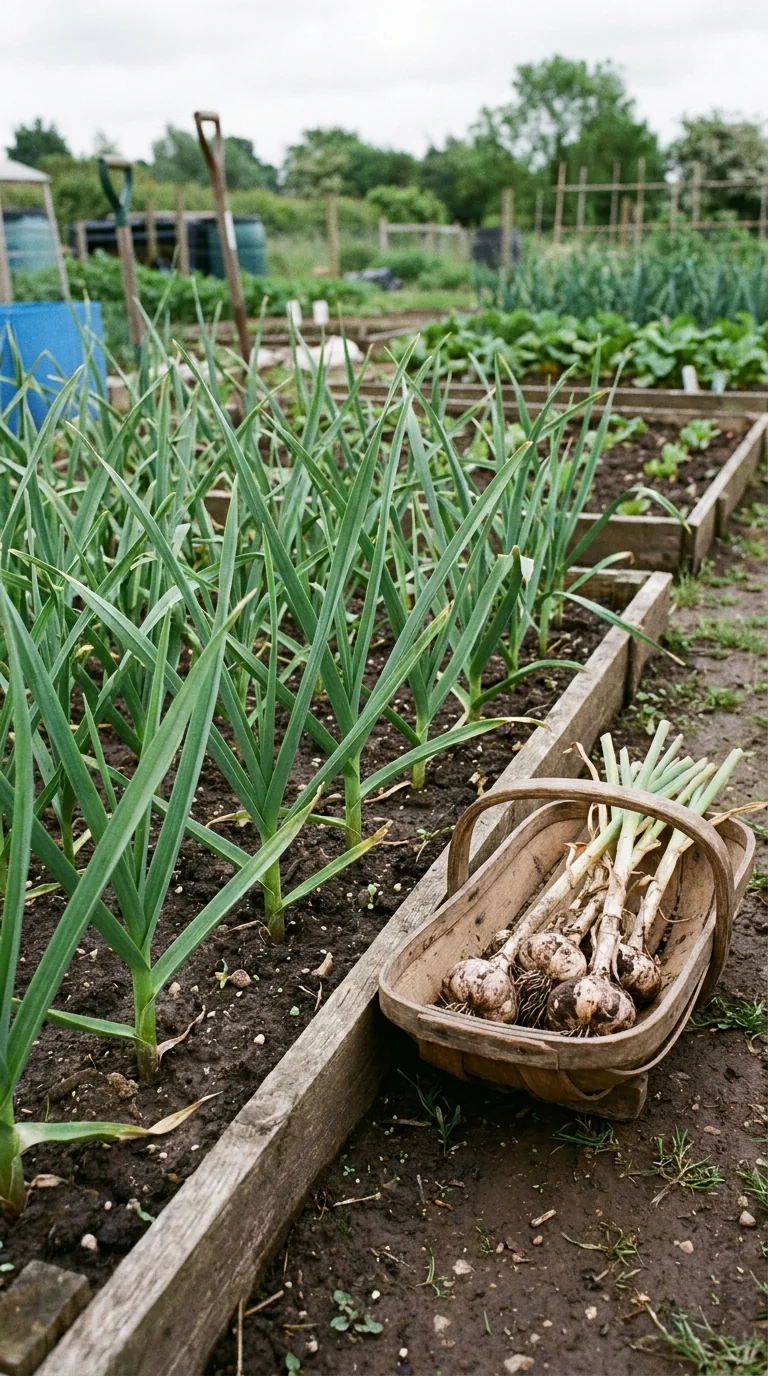
Garlic is a useful crop for a UK garden because much of its growing cycle can begin when summer vegetables are being cleared. Planting individual cloves is straightforward, but the final result depends on suitable stock, seasonal timing and drainage. A clove that sits in saturated winter soil may rot before it has the opportunity to form a useful bulb.
Choose garlic intended for planting and matched to your chosen season. Autumn planting suits many varieties, while selected varieties can be planted in late winter or early spring. These are alternatives with different constraints, not interchangeable dates for every bulb. Keep the variety label through to harvest so you can learn which performs well in your garden.
Choose between hardneck and softneck garlic
Hardneck garlic usually produces a central flowering stem, called a scape, and often has fewer larger cloves. Softneck garlic generally lacks a stiff central stem and can be easier to plait once cured. Storage potential varies by variety and conditions, so use the supplier's description rather than assuming every softneck or hardneck behaves identically.
Think about kitchen use. Large cloves are convenient for some recipes, while smaller cloves may suit a household using small quantities at a time. If you want to store most of the crop, keeping quality matters as much as bulb size. If you mainly want fresh garlic, an earlier useful harvest may be the greater priority.
Elephant garlic is a related but different crop and should not be used as the model for ordinary garlic spacing and expectations. Likewise, a supermarket bulb does not tell you whether it suits your climate or carries planting risks. Buy named planting stock from a reputable supplier for a more reliable starting point.
Autumn and spring planting compared
| Approach | Useful situation | Main caution |
|---|---|---|
| Autumn planting | Suitable variety and free-draining ground | Wet winter soil can cause losses |
| Autumn start in modules | Garden soil stays too wet for direct planting | Plants still need light and timely transplanting |
| Late winter or spring planting | Variety specifically suited to it | Do not delay beyond its recommended window |
Many garlic varieties benefit from a period of cool conditions for good bulb division. This is one reason autumn planting is common. Spring-suitable varieties provide another option, but planting any spare autumn bulb very late does not guarantee the same result. Follow the cultivar's requirements rather than treating garlic as a crop with unlimited timing flexibility.
In mild wet areas, drainage may be a more urgent concern than low temperature. In a cold garden, the ground may freeze or become unworkable. Prepare before conditions deteriorate and plant only when the soil can be handled without smearing and compaction.
Buy and inspect planting material
Choose firm bulbs with sound skins and no obvious soft patches or mould. Keep them dry and airy until planting. Break the bulb into individual cloves shortly before use, avoiding damage to the basal plate where roots develop. Leave the clove's papery covering in place rather than peeling it as if preparing it for cooking.
Use the better-sized healthy cloves for your main crop. Very small cloves may form smaller bulbs and are useful for a separate trial or green-garlic harvest if desired. Label that trial so you do not confuse its results with your main planting. Reject obviously diseased or collapsing material rather than hoping the garden will restore it.
Count the usable cloves before preparing the full bed. One bulb's clove number varies, and not every clove deserves the same planting space. A quick count makes it easier to mark a realistic row and avoids either wasting prepared ground or forcing surplus cloves too close together.
Prepare an open, well-drained position
Garlic needs sunshine and soil that drains well. Remove perennial weeds before planting because established garlic is awkward to weed around and does not suppress strong competitors effectively. Incorporate well-rotted organic matter where it benefits the soil, avoiding fresh manure directly around cloves.
If the ground stays puddled, investigate the cause rather than adding a little grit and expecting an instant solution. Raised beds or containers may offer a more controllable environment, but neither works if excess water remains trapped. Observe the site after rain before deciding it is suitable for overwintering.
Garlic dislikes strongly acidic conditions. Test soil before considering lime and follow a measured recommendation rather than adding it every autumn as a ritual. An untested treatment can create a different imbalance. Containers filled with suitable multipurpose compost usually do not need improvised pH adjustments.
Plant the right way up
Place each clove with its flat basal end down and pointed tip upwards. A useful spacing is about 15cm between cloves and 30cm between rows. Plant so the tip sits approximately 2.5cm below the soil surface, adjusting where the cultivar and soil conditions require a different depth. Avoid burying cloves deeply in heavy wet soil.
Make individual holes with a dibber or small trowel rather than forcing cloves into hard ground. Settle the soil gently around them. Planting depth refers to the clove's position relative to the finished surface, so account for any mulch rather than measuring from a temporary loose heap.
Birds sometimes pull newly planted cloves up. Check the row while rooting begins and use suitable temporary protection if needed. Secure any mesh properly and keep it clear enough for shoots to emerge. Replant sound displaced cloves promptly rather than leaving roots exposed to dry out.
A module start for wet winter ground
Use individual modules large enough for roots to develop, filled with suitable peat-free compost. Plant one clove per cell and keep the tray in a bright unheated greenhouse or cold frame. The purpose is avoiding saturated garden soil, not raising soft growth in a hot room.
Water sparingly according to the compost's condition, keeping it moist enough for rooting but never permanently soaked. Check trays after heavy rain if they are in a partly open frame. Label the variety and planting date and plan where the plants will move when the bed becomes workable.
Transplant before roots become badly congested. Water the cells, lift rootballs intact and place them at suitable spacing and depth. Avoid tearing roots apart to separate a crowded module. Acclimatise protected plants as needed, and do not move them into a bed that is still saturated simply because the tray is becoming full.
Grow garlic in containers
A broad, deep container with drainage holes offers a useful alternative where ground conditions are unsuitable. Fill it with suitable peat-free multipurpose compost and space cloves sensibly, leaving room between them rather than filling every gap. A container about 30cm deep provides a more useful rooting volume than a shallow decorative bowl.
Place the pot in a sunny position where winter rain can drain away. Do not leave it standing in a saucer of water. Check the base occasionally for blocked holes, especially if leaves or soil wash underneath it. A pot can also dry out in cold windy weather, so winter care is not simply ignoring it until spring.
During active growth, containers may need more regular watering and feeding attention than garden soil. Use the compost and fertiliser instructions as a guide. Their limited space also limits the number and potential size of bulbs, so set expectations accordingly rather than comparing one pot with a full allotment row.
Keep growth steady in spring
Weed by hand while weeds are small, taking care not to damage shallow roots or developing bulbs. A tool driven close to the stem can do more harm than the weed you are removing. Keep labels visible as foliage grows and inspect the whole row, including its shaded edge.
Water during dry periods while plants are actively growing and bulbs developing. Check the soil rather than assuming spring rainfall has supplied enough. Later, as maturity approaches, avoid unnecessary watering that keeps bulbs wet. The timing of that change depends on the plants and weather, not a universal date.
Feed appropriately where soil or compost requires it, following the product's recommended rate. Strong late feeding is not a way to rescue bulbs that are already approaching harvest. If foliage yellows unexpectedly early, investigate roots, drainage and disease before assuming a nutrient shortage.
Manage scapes and recognise normal ageing
Hardneck garlic may produce a curling scape that later straightens. Removing it when young is commonly used to direct growth towards the bulb; the tender scape can also be used in cooking if sound and correctly identified. Do not mistake every ordinary upright leaf for a flower stem.
The presence of a scape does not mean the plant has failed like an onion that bolts unexpectedly. It is a normal characteristic of hardneck garlic. Keep this distinction clear when growing both crops. Use the variety label and inspect the actual structure rather than applying one allium's advice to every related plant.
As harvest approaches, lower leaves begin to yellow and die. Gradual seasonal decline differs from sudden patches of collapsing plants. Check whether neighbouring garlic is at a similar stage and whether the expected harvest period is near before deciding the crop has a disease problem.
Watch for rust and white rot
Garlic rust commonly produces orange pustules on leaves. The effect varies with severity and timing, and a late infection does not automatically make sound bulbs unusable. Maintain reasonable spacing and avoid moving infected plant material unnecessarily. Confirm the problem before deciding on any crop treatment.
White rot is more serious for future allium growing because its resting structures can persist in soil. Suspect signs include root and bulb decay with white fungal growth and small dark bodies near the base. Remove affected plants carefully and avoid transferring contaminated soil on tools or footwear to clean beds.
| Observation | Check | Useful first response |
|---|---|---|
| Cloves disappear or rot | Drainage and planting-stock condition | Correct the site before replanting |
| Orange leaf spots | Possible rust | Inspect spread and seek confirmation |
| Sudden plant collapse | Roots, bulb base and surrounding soil | Handle suspect material carefully |
| Small undivided bulbs | Variety, planting time and growing conditions | Review the planting plan for next year |
Lift when the bulbs are ready
Harvest commonly falls in summer, with timing influenced by variety and planting date. Look for yellowing foliage and inspect a test bulb rather than waiting until every leaf has completely disappeared. Leaving mature garlic too long can allow bulbs to split apart, reducing their suitability for storage.
Loosen soil with a fork set away from the bulb and lift carefully. Do not pull hard on the stem in dry compact soil, and avoid striking cloves with the tool. Handle bulbs gently and keep each variety separate if you intend to assess keeping quality.
Cure and store sound bulbs
Spread harvested garlic in a dry, airy place protected from rain. Leave foliage attached while the bulbs dry, and do not seal fresh garlic into plastic packaging. Good airflow is important; a closed humid shed corner can keep necks damp even when skins appear dry.
Once thoroughly cured, trim roots and foliage as appropriate for storage, or plait suitable softneck types. Brush away loose dry soil rather than soaking bulbs. Separate damaged, split or suspect examples from the storage batch. Discard rotten material and use otherwise sound damaged bulbs promptly.
Store in a cool, dry, ventilated location and inspect periodically. A very warm kitchen shelf may encourage decline, while frost and damp create other risks. Save planting cloves only from sound suitable stock where disease concerns are absent; do not perpetuate a problem simply because a bulb was large.
Use your records for the next planting
Record planting date, variety, drainage issues, harvest readiness and the number of sound stored bulbs. Compare autumn and spring approaches only with their different varieties and conditions in mind. One wet winter is useful experience, but it does not prove that autumn planting always fails in your area.
For a crop that gives quicker feedback during the main season, see growing radishes from seed in the UK. Keep it in a suitable separate space so its fast harvest does not disturb garlic roots while the bulbs are still developing.
At harvest, photograph a representative bulb beside its label and a ruler for your own records. This is more informative than remembering only the biggest example. Compare average usable bulbs and storage losses before deciding whether a change of planting season improved the crop.

