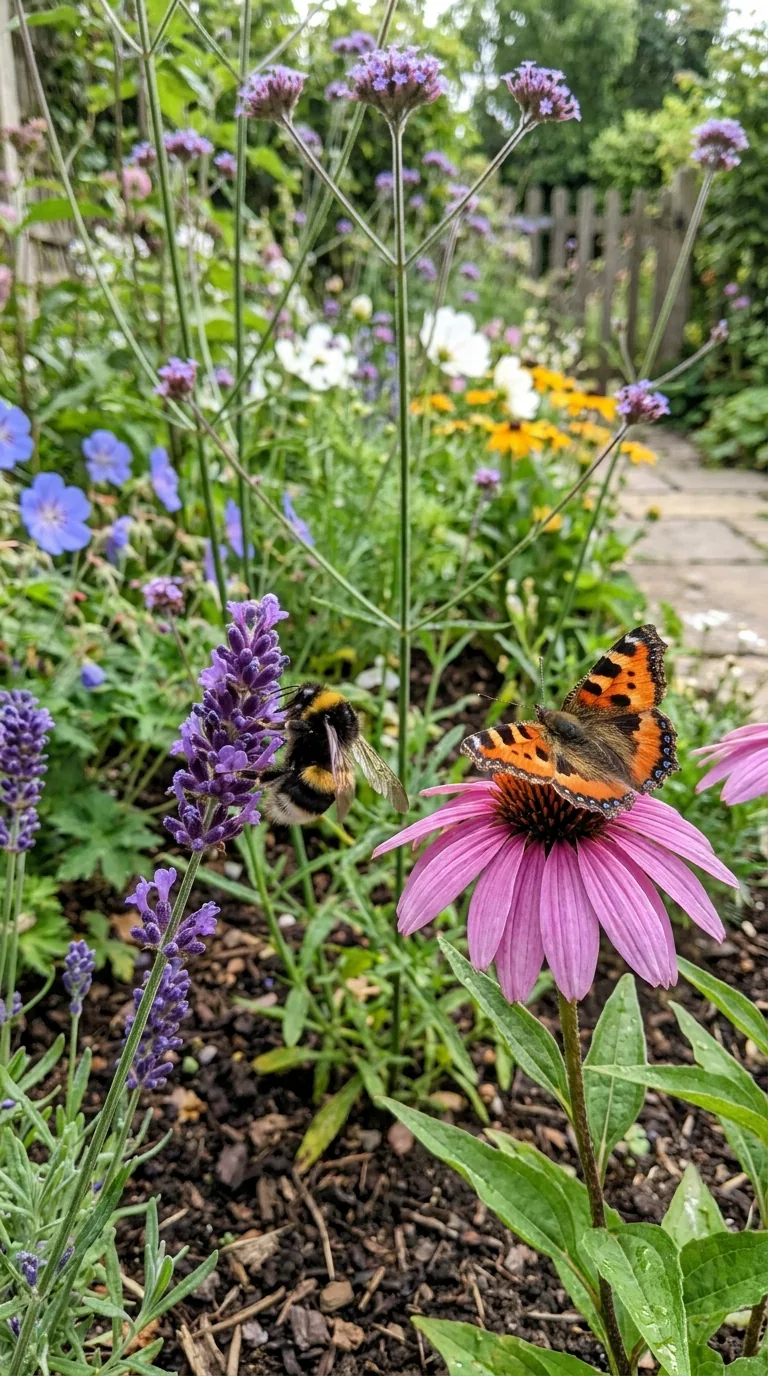
A pollinator-friendly flower garden begins with useful flowers across the year rather than a single spectacular summer display. Bees, butterflies, hoverflies and other flower visitors have different needs and activity periods. A planting can provide nectar and pollen without meeting every part of an insect’s life cycle. Treat flowers as one part of a garden that also offers suitable habitat, shelter and careful management.
There is no universal list of flowers that performs equally well in every UK garden. Soil, light, weather, cultivar and the insects present all affect results. The practical aim is a varied, healthy planting with accessible flowers and fewer empty periods. You can make progress in a pot, a border or a larger patch, provided plants are chosen for the conditions and allowed to flower.
Look for gaps in the flowering year
Record what is actually flowering in your garden at different times. A border crowded with midsummer colour can be almost empty in early spring or late autumn. Those gaps are easy to overlook while shopping when nurseries mainly display whatever is currently attractive. Make a simple calendar with one row per plant and mark the months when it flowers locally. Revisit it after the first season rather than assuming packet dates are exact.
Early and late flowers are especially useful additions where the garden already has plenty of summer blooms. Some insects become active during mild spells, but winter flowering does not guarantee winter visitors in every location. Exposure, sunshine and temperature matter. Position early flowers where they receive available light and are not continually shaded by evergreen foliage. Choose a succession of plants rather than expecting one species to flower indefinitely.
| Part of the year | Possible flowers | Position to check | Planning caution |
|---|---|---|---|
| Late winter to early spring | Snowdrops, suitable crocuses, hellebores | Seasonally light beds or containers | Flowering shifts with weather and cultivar |
| Spring | Pulmonaria, primroses, flowering herbs as they develop | Match each plant to moisture and shade | Not every shaded area is moist |
| Early summer | Chives, alliums, hardy geraniums | Suitable borders and mixed herb beds | Allow plants to flower before cutting |
| Midsummer | Lavender, catmint, borage, single-flowered annuals | Mostly sunny sites with appropriate drainage | Check eventual size and self-seeding |
| Late summer into autumn | Single dahlias, suitable asters, Hylotelephium | Open beds with space for mature plants | Late flowers still depend on local frost |
This table is a starting framework, not a promise that all these plants will suit one bed. A dry sunny gravel border and a damp shaded strip need separate palettes. Choose fewer plants that will grow well rather than a complete seasonal list struggling in the wrong soil. If a winter-flowering shrub would outgrow the garden, a more compact alternative or a shared neighbourhood resource may be more realistic.
Accessible flowers matter more than a fashionable label
Flower structure affects access to nectar and pollen. Many heavily doubled flowers have extra petals that can obstruct or replace the parts insects use. Single or semi-double forms with visible central structures are often a useful starting choice. That does not mean every single flower serves every pollinator. Some insects can reach deep tubular flowers, while others use flatter, more open arrangements.
A diverse planting can include daisy-like flowers, flower spikes and open clusters. Hoverflies may use flowers differently from long-tongued bumblebees. Butterflies often need a landing place and sunny conditions for feeding. Avoid choosing only one flower shape because it attracted many insects on one afternoon. Build variety, then observe which visitors actually use the plants over a season.
The RHS Plants for Pollinators information is a useful selection aid, but it should be combined with plant suitability and local observation. A plant included in a pollinator scheme still needs enough light, water and space to become healthy and flower. A label does not guarantee insect abundance in a particular pot, nor does it establish that every cultivar of the same species offers identical resources.
Use sunny positions well
A sunny, sheltered border can support many familiar nectar-rich flowers. Shelter reduces the effect of strong winds and helps insects move between flowers, but a dense barrier that creates deep shade can undermine the planting. Assess the mature height of nearby shrubs and climbers. A sunny patch in March may be shaded by a deciduous tree in June, when the plants you have chosen are expected to flower.
Combine plants with similar soil needs. Lavender and other dry-site plants are a poor match for a permanently damp hollow. Thirstier plants can be grouped where soil holds moisture rather than repeatedly watering an entire dry border. Matching water requirements reduces maintenance and helps plants reach their flowering potential. It also avoids the assumption that wildlife gardening requires neglect.
For a new bed, place a few repeated groups instead of one specimen of every flower on a long list. Repetition creates visible patches and makes watering and maintenance easier. Leave enough distance for mature growth and put supports in before plants lean over. Flowers crowded into a dense wall may have fewer accessible blooms and more disease problems than a planting with room for air movement.
Shady gardens can still offer flowers
Shade is not one uniform condition. Open shade beside a building differs from dry ground under a dense tree or moist shade at the bottom of a slope. Some plants flower before deciduous trees develop their summer canopy. Others need part shade and reasonably moisture-retentive soil. Observe light at several times of day and consider the season rather than deciding that a garden is simply “too shady”.
Pulmonaria and suitable hardy geraniums can be considered for appropriate shaded positions. Spring bulbs may use light beneath deciduous trees before leaves expand. Check each plant’s requirements and growth habit, including whether it spreads strongly. Do not dig deeply among valuable tree roots to install a flower patch. Containers may offer an alternative where the ground is too root-filled, provided watering and placement remain practical.
In very deep shade, improving habitat structure may be more sensible than forcing an abundant flower display. Retaining suitable leaf litter, providing varied vegetation and avoiding unnecessary disturbance can have value even where flowers are limited. A sunny container near the brighter edge of the garden may supply more usable flowers than repeatedly replacing sun-loving plants in an unsuitable dark corner.
Group plants without overcrowding them
Think in terms of a patch insects can find and you can maintain. A few plants of the same suitable flower can provide a stronger display than scattered isolated individuals. At the same time, each needs its proper mature spacing. Grouping is not close packing. Put labels or temporary markers down before planting so that the empty spaces needed for future growth remain visible.
For example, a border three metres long and one metre deep has three square metres of ground, but it is not necessarily suitable for twelve large perennials. If each chosen plant is expected to spread around 60 centimetres, their outlines soon overlap. Sketch the mature circles on paper and leave access at the edge. Smaller spring bulbs can occupy some seasonal gaps without permanently crowding summer plants.
A narrow border may be better served by three complementary species repeated than by fifteen different types. Choose an early flower, a summer mainstay and a late-flowering plant that share site needs. Add other seasons gradually. This approach keeps identification and maintenance manageable and makes it easier to see which part of the year still needs attention.
Containers need a resource plan too
One large pot generally offers a more stable growing environment than a collection of tiny pots, though it is heavier and less movable. Use containers with drainage holes and a peat-free medium suited to the plants. Match root volume and mature size to the pot rather than relying on a nursery display where small flowering plants are temporarily packed together.
Container flowers require monitoring because restricted roots dry out more readily than roots in open ground. Check the compost, especially in wind, and water the root area when needed. Feeding may become necessary after the medium’s initial nutrients are used. Follow the product label; overfeeding and water stress can both reduce the useful flowering period. An unattended pot that dries out repeatedly is unlikely to provide reliable flowers.
On balconies, secure containers against falling and check any loading or building restrictions before installing large planters. Keep escape routes and doorways clear. Avoid positioning a busy flower pot where people must brush past it in a very narrow passage. A modest shift in placement can allow both people and visiting insects to use the space comfortably.
Manage the garden without undoing the planting
Avoid routine pesticide use around flowers. Identify a problem before acting and consider whether the damage needs intervention. A few chewed leaves or aphids do not necessarily threaten a plant’s survival. Encourage balanced management through healthy plants, appropriate watering and observation. Do not spray flowers simply because a product is sold as natural; origin alone does not establish that it is harmless to pollinating insects.
Deadheading can encourage further flowers on some plants, but leave selected seed heads where useful. Vary the treatment across the bed instead of tidying everything at once. Likewise, avoid cutting every flowering herb on the same day. If you grow chives or other herbs, allow part of the planting to bloom while retaining another section for kitchen use.
Where lawn is present, allowing suitable flowers to develop in a portion can add resources, depending on the existing plants and how the area is used. Keep access and play areas usable. A small managed patch with a clear edge is easier to integrate into a home garden than an unplanned area that becomes difficult to maintain. Remove invasive or troublesome plants before they dominate valuable habitat.
Remember butterfly caterpillars and nesting habitat
Adult butterflies use nectar, but their caterpillars depend on particular food plants. A nectar-rich border alone does not support the complete life cycle of every butterfly that visits. If you want to help a specific species, identify its larval food plants and whether they can be accommodated appropriately. Do not assume a general “butterfly flower” supplies caterpillar food.
Bees also have different nesting requirements. Some use cavities, some nest in the ground, and others use suitable vegetation or sheltered spaces. Flowers should be combined with thoughtful habitat provision where possible. Avoid installing novelty nesting structures without understanding their maintenance requirements. Cleanliness, dryness and appropriate design matter; an attractive insect hotel is not automatically useful.
Leave a balanced mixture of vegetation and undisturbed areas while keeping the garden safe and manageable. A pile of suitable cut stems or a small area of bare ground can have a different role from a flower pot. Avoid moving occupied nests or disturbing wildlife simply to arrange the garden neatly. Observe first and adapt maintenance around what is present.
Observe visitors and improve the next season
Choose a short, repeatable observation period and record weather, flower condition and broad visitor groups. Comparing a sunny calm afternoon with a cold wet morning tells little about plant preference. Use similar conditions when possible, and avoid claiming precise population changes from a few casual counts. Photographs can help with identification, but do not handle or trap insects just to obtain a better image.
Sunflowers can provide a different flower form and, when fertile heads mature, later seed resources. The guide to growing sunflowers from seed explains how to choose a suitable height, protect young plants and leave selected heads without treating every sunflower cultivar as identical.
At the end of the year, review three things: when flowers were absent, which plants stayed healthy and which maintenance jobs were difficult. Add plants to solve those specific gaps. A useful pollinator garden is an evolving combination of flowering succession, appropriate plants and considerate care. More flowers can help provide resources, but honest observation is a better measure of progress than promises that one border will rescue every local pollinator.
Buy plants with the whole season in mind
When shopping, carry the flowering calendar and the dimensions of the intended gap. A nursery full of flowers can make it tempting to buy another midsummer plant even when that season is already well covered. Ask about cultivar identity and growing conditions, and avoid plants that cannot be accommodated at their mature size. A smaller well-matched addition that fills a genuine early or late gap can be more useful than another large summer specimen.

