A small vegetable garden becomes useful when it fits the light, access and attention available. Pots, climbing supports and compact beds can make limited space productive, but they do not remove the needs of mature plants. Roots require room, leaves need light and containers need dependable water. The aim is to choose a manageable combination rather than fill every surface with something growing.
Begin by deciding what the space must still do for the household. A patio may be a route to the back door, a place to sit or somewhere to dry washing. A balcony has loading and safety constraints. Keep those functions visible in the plan. A smaller growing area that remains easy to use is usually more sustainable than an arrangement that blocks everyday movement.
Map the available light honestly
Observe the space at several times of day and note where direct sun reaches the ground or containers. Buildings, fences and neighbouring vegetation can create sharply different conditions within a few metres. Recheck as seasons change. A sunny spring wall can become shaded by a tree in summer, while a balcony may receive only a short period of strong afternoon light.
Fruiting vegetables generally need good light to crop well. Some leafy crops and herbs can tolerate partial shade, though growth and harvests may be slower. Do not interpret shade tolerance as a promise of abundant production in a dark passage. If light is very limited, a few suitable herbs or ornamental plants may be a more realistic use than a crowded collection of tomatoes.
Wind and reflected heat can complicate a small space. A south-facing paved corner may become hot and dry, while an elevated balcony can be exposed even when the street feels calm. Note where pots tip, foliage is battered or compost dries fastest. Use these observations to choose crops and container positions rather than assuming the smallest footprint is always the best arrangement.
Choose crops for harvest style as well as size
Small repeated harvests often suit limited space. Cut-and-come-again leaves, a few herbs and compact beans can provide useful pickings without requiring a large area to be cleared at once. A single courgette may yield generously but occupies a broad patch of foliage. Potatoes can be grown in containers, yet the container remains committed for much of the season before its main harvest.
Think about what you eat regularly. A fresh herb you use several times a week may justify its pot more readily than a crop grown only because it is fashionable. Consider the whole mature plant, not just edible output. Tall crops need support; trailing crops need somewhere to trail; root crops need an appropriate unobstructed growing depth.
| Priority | Possible crop approach | Limit to plan around |
|---|---|---|
| Frequent small pickings | Salad leaves and suitable herbs | Regular sowing, watering and harvesting |
| Use a sunny vertical zone | Climbing beans or suitable peas | Secure support, shade and root volume |
| One substantial summer container | A suitable compact tomato | Light, water, feeding and cultivar habit |
| Short seasonal crop | Radishes or small salad batches | Heat, moisture and cultivar timing |
| Root-crop experiment | Short-rooted carrots in a suitable pot | Depth, thinning and consistent moisture |
Compact cultivars can help, but the word “patio” does not remove care requirements. Check the label’s mature dimensions and recommended container size. A compact tomato can still become thirsty and heavy with growth. Avoid combining several full-sized plants in one small pot because they looked comfortable as seedlings.
Layout one: a sunny two-by-three-metre patio
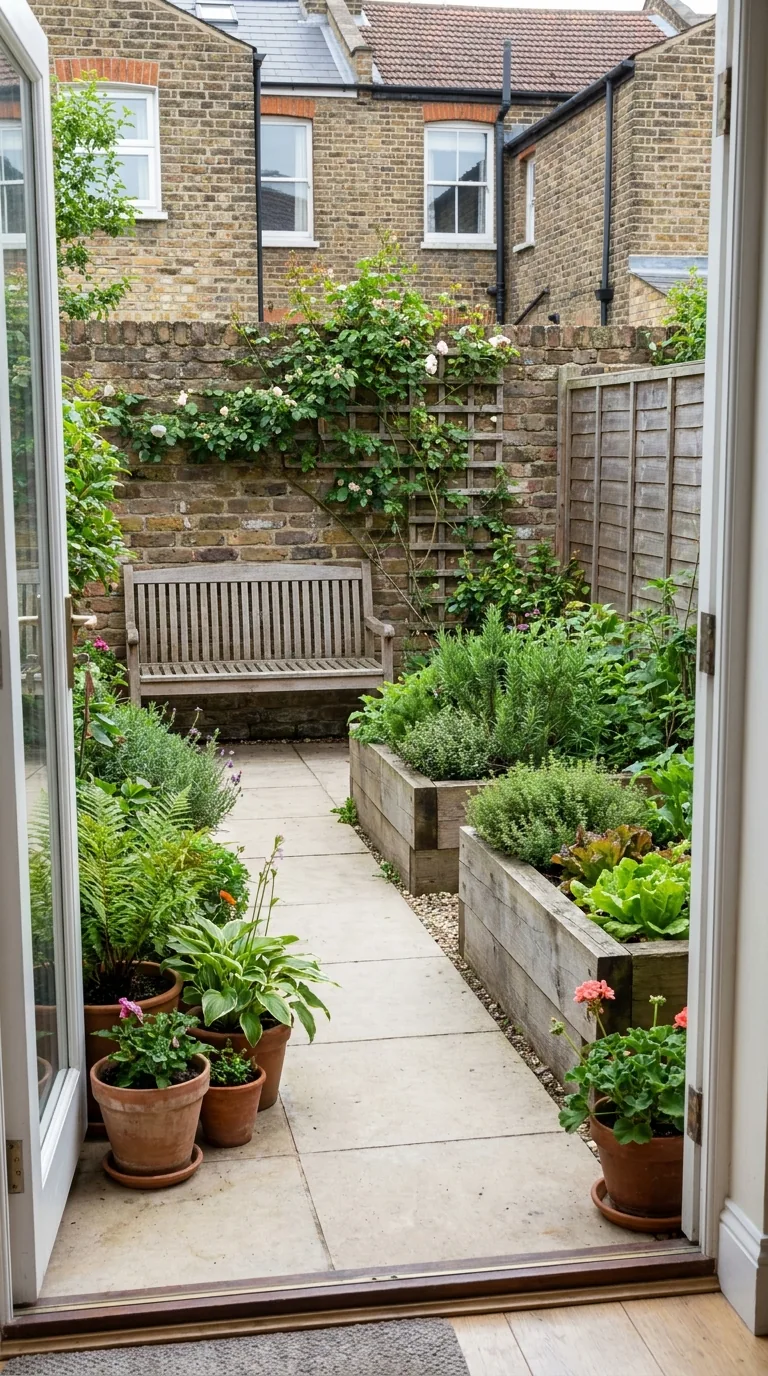
Imagine a patio two metres deep and three metres wide with the back door opening onto one short edge. Keep a clear route from the door before placing any pots. A line of substantial containers along the sunny outer edge can leave the centre usable. Place the thirstiest crop near the water route and keep lower pots where they can be reached without leaning over larger plants.
One possible first season uses a suitable tomato in its own large pot, a broad salad container and two modest herb pots. Add a secure support only if the chosen tomato needs one. This is intentionally a small collection. It allows you to learn how quickly the patio dries and how much watering can be maintained before adding more plants.
Measure mature canopy outlines as well as pot diameters. Four pots each 40 centimetres wide do not necessarily occupy only 1.6 metres of usable edge once leaves and access are included. Keep enough room to inspect compost and harvest from the back. Arrange saucers or drainage carefully so water does not create slippery areas near the door.
Layout two: a narrow bed beside a fence
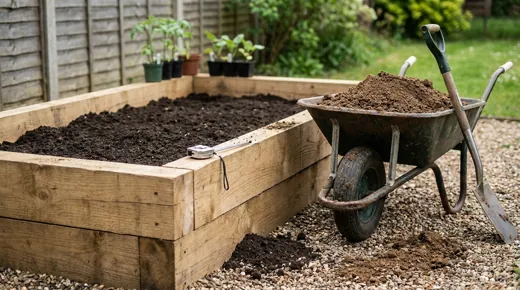
Consider a bed four metres long and 70 centimetres wide, accessible only from the path. That width may be workable for some gardeners, but test the reach before planting. Keep the fence side for a suitable restrained support if light permits, and avoid filling the entire length with tall crops that shade everything in front.
A short vertical section at one end can leave the rest for lower vegetables. Use crop-specific spacing rather than a dense mixed sowing that becomes impossible to weed. Mark the area needed for mature foliage near the path. If courgette leaves would occupy most of the walkway, choose another crop or a different position instead of planning to remove healthy leaves continually.
Fence ownership and strength matter. Do not attach heavy supports to a neighbouring structure without permission, and do not assume decorative fence panels can carry a large climbing crop in wind. A freestanding support may be appropriate if securely installed. Check underground services before driving posts and keep access to the fence for maintenance.
Layout three: a partly shaded balcony
A balcony requires safety and building checks before large containers are installed. Confirm loading limits and any rules about attached planters, drainage and wind exposure. Wet compost is heavy, and the structural question cannot be answered from a pot’s footprint alone. Keep every container secure and prevent tools, supports or pots from falling over the edge.
If the balcony has only partial light, begin with a few suitable leafy crops or herbs rather than ambitious fruiting vegetables. Position pots where the brightest available light reaches them without blocking the door or escape route. A stable low container may be more manageable than several high hanging planters that are difficult to water safely.
Drainage must not inconvenience people or property below. Use an arrangement that collects or directs excess water safely while avoiding prolonged waterlogging. Check containers after rain as well as after watering. Wind can increase moisture loss quickly, so start with a small enough collection that daily inspection is realistic during demanding weather.
Use vertical growing without ignoring shadows
Vertical supports can move foliage into available light and free some ground surface, but the plants still occupy volume. Climbing beans need a substantial root zone and cast shade as they develop. A stack of pots can shade lower tiers and make watering uneven. Choose a system based on actual light and maintenance access, not only the number of planting pockets advertised.
Install supports before growth becomes heavy. Use appropriate fixings and check stability in wind. Avoid overhead cables and sharp ends near faces or eyes. If the structure requires a ladder for routine harvesting, reconsider whether it is suitable for the space and user. A slightly lower harvest may be more useful than unreachable produce at maximum height.
Do not confuse climbing habit with automatic attachment. Some plants twine, some use tendrils and others need tying. Match the support material and spacing to the crop. Check ties as stems thicken and redirect growth early while flexible. A plant that has woven through neighbouring pots is harder to separate without damage.
Select containers by usable volume
Pot diameter alone can be misleading because shallow bowls, straight-sided tubs and tapered pots have different capacities. Check labelled volume where available and inspect drainage holes. Containers used previously should be cleaned and have a known suitable history; avoid vessels that held unknown chemicals. For edible crops, use materials intended for an appropriate growing purpose.
Choose a suitable peat-free growing medium rather than digging heavy garden clay into pots. Container media need to balance air and water within a confined space. Product formulations differ, so observe moisture behaviour after watering. A dry surface does not always mean the whole root zone is dry, and a permanently wet pot needs investigation rather than more feed.
Leave a watering margin below the rim. In a crowded patio, water spilled over the edge can make the compost appear soaked while the roots remain dry. Water slowly enough for infiltration and allow excess to drain. Avoid standing susceptible crops continuously in water-filled saucers unless the particular growing system is designed for that.
Make succession manageable
Succession works particularly well when you sow small batches and know when a container will become available. A short salad crop can be followed by another appropriate sowing, but later crops must suit the remaining daylight and temperatures. Do not treat an empty container as an instruction to sow any vegetable at any time of year.
Keep a simple calendar with sowing, expected harvest and replacement windows. For example, divide a salad container into two areas and sow one first, then the other later if conditions remain suitable. This can spread harvesting without producing a large glut. The exact interval depends on crop, weather and how quickly the household uses the leaves.
Have a place for the next seedlings that does not block access. A small tray on a stable well-lit surface may be enough. Avoid raising many reserves for a garden that has no spare planting space. When the first crop runs late, adjust the plan rather than forcing a second crop into a crowded root zone.
Put water and attention into the budget
Small-space gardens can be labour-intensive if they contain many separate pots. Each is its own root environment, and one may dry while another remains wet. Grouping pots with similar needs simplifies checking, but do not crowd their leaves so much that airflow and access disappear. Keep a small watering can or hose route practical for the actual user.
A basic watering calculation helps illustrate scale. One millimetre of water over one square metre is one litre. Thus a 10-millimetre application across a two-square-metre bed represents 20 litres before losses. This is a unit conversion, not a recommendation to apply that amount every day. Actual need depends on moisture, crop stage and weather.
Plan holiday care before planting thirstier crops. A neighbour or friend needs clear instructions about checking compost, not just a fixed number of cans. Test any irrigation system before relying on it, and inspect outlets for blockage. A simpler display with larger stable pots may be more realistic than a complex wall of small pockets needing frequent attention.
Keep access and tidiness functional
Leave room for the tasks that happen repeatedly: reaching the tap, setting down a bucket, opening the door and removing spent crops. A plant can be healthy while its placement remains inconvenient. Move or reduce the planting before it turns into a daily obstacle. Do not rely on repeatedly dragging a heavy wet pot out of the way.
Harvest promptly and remove failed or finished crops so the small area remains useful. Inspect pests and diseases rather than assuming close spacing will make problems inevitable or impossible. Give healthy plants suitable conditions, identify damage and intervene proportionately. Avoid routine spraying around flowering crops or herbs without a clear need and appropriate guidance.
If you are beginning with bare ground rather than an established patio, the guide to starting a vegetable garden from scratch explains how to assess soil, choose a manageable first area and plan the initial season before adding containers and supports.
Review usefulness after the first season
Record what you harvested, which containers needed the most attention and where movement became awkward. A crop that produced a modest amount but was used frequently may deserve its place again. One that occupied a large pot without matching your eating habits may be replaced. Evaluate the garden against your own use rather than comparing photographs of much larger plots.
Change one constraint at a time: improve a watering route, select a better-sized cultivar or remove one badly placed container. Small spaces reward clear choices. With realistic light assessment, secure placement and enough root room, a few well-kept crops can provide a useful introduction to growing without taking over the entire outdoor area.