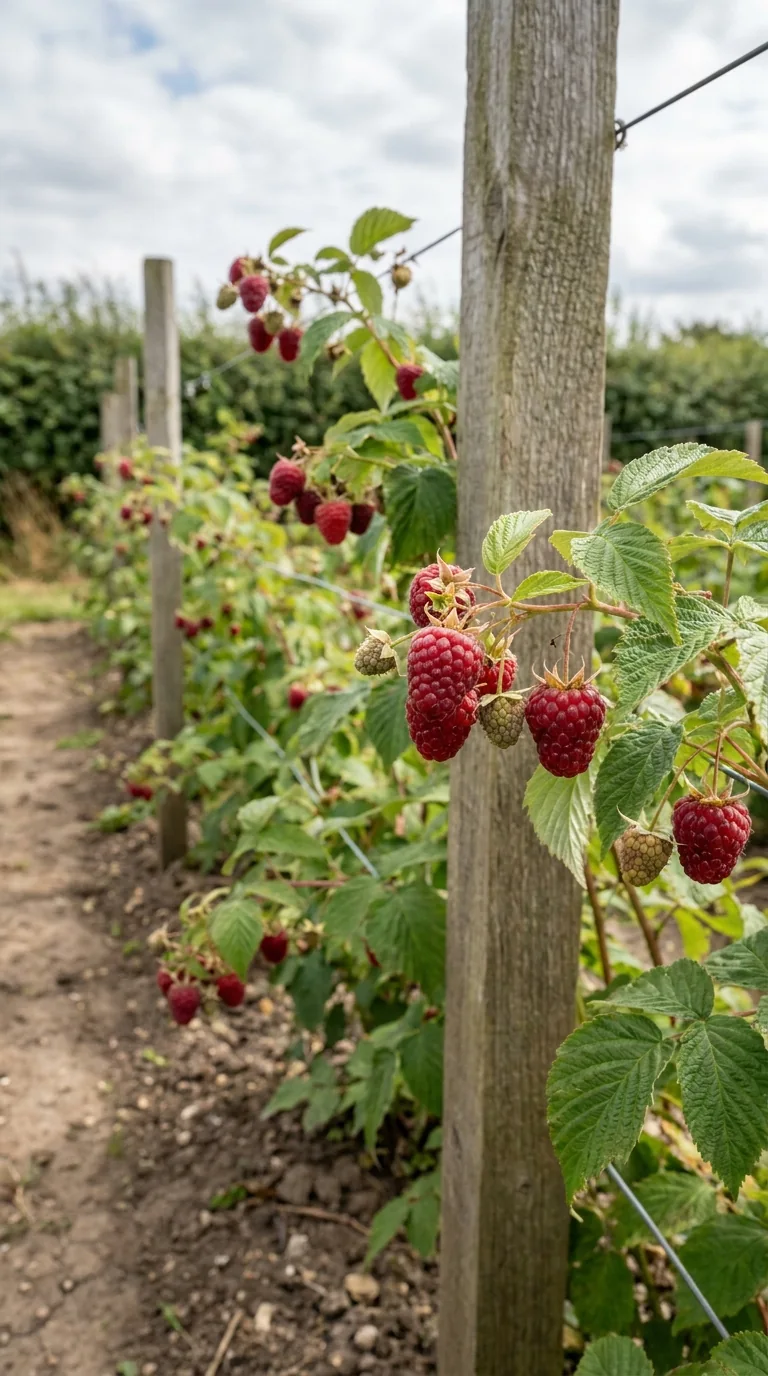
Raspberries are rewarding garden fruit when their canes are supported, their roots stay reasonably moist and the correct stems are retained for the next crop. The most important first step is identifying whether you have a summer-fruiting or autumn-fruiting variety. The roots are perennial, but individual canes have a shorter working life. Pruning every plant to the ground at the wrong time can remove the wood that would have carried your summer berries.
A well-managed row does not need to become a thicket. Give it enough space at planting, install supports before long canes develop and remove unwanted suckers as they appear. A small number of healthy, well-lit canes is easier to pick and inspect than a crowded mass with inaccessible fruit. Plan access on both sides if the site allows.
Understand the two main cropping types
Summer-fruiting raspberries produce their main crop on canes that grew during the previous year. While those canes flower and fruit, fresh canes grow from the base to supply the following year's crop. After picking finishes, remove the canes that have fruited and retain selected healthy new ones. Keeping track of these two generations is the central task.
Autumn-fruiting raspberries produce fruit on the current season's growth, usually from late summer into autumn. For a straightforward single autumn crop, cut all the canes down during the dormant period in late winter. New shoots grow in spring and fruit later that same year. This simple system is useful for beginners, although an early frost can curtail the final harvest in colder places.
Some autumn cultivars can be managed for two crops by retaining part of the canes, but that adds complexity and changes the balance of production. Start with the simple single-crop method unless you have a reason to experiment. Do not apply a double-cropping system to an unidentified summer variety. Keep labels and a photograph of the row's fruiting pattern for future reference.
| Type | Where fruit develops | What to remove | What to retain |
|---|---|---|---|
| Summer-fruiting | Canes grown in the previous year | Spent canes near ground level after harvest | Selected healthy new canes for next summer |
| Autumn-fruiting | Fresh canes grown that spring | All canes near ground level in late winter | Fresh shoots as they emerge in spring |
Choose varieties for your season and space
Early, mid-season and late summer cultivars spread the summer harvest if you have room for more than one. Autumn cultivars differ in earliness, vigour and fruit quality. In a short northern growing season, an earlier autumn selection may be a more practical choice than one advertised mainly for very late berries. Match the harvest window to local conditions rather than assuming every catalogue date will occur in your garden.
Most ordinary raspberries are self-fertile, so you do not usually need a second cultivar as a pollination partner. Multiple varieties are useful for harvest timing, not automatically a requirement for fruit set. Buy healthy planting material from a reliable nursery and avoid collecting unlabelled suckers from a patch with declining growth or unexplained disease.
Check whether purchased plants are ordinary bare-root canes, container-grown plants or specially prepared long canes. Long-cane summer raspberries may be intended to crop from the supplied cane; cutting it down at planting can remove that season's fruit. Follow the supplier's instructions for the exact material instead of treating every delivery as the same product.
Prepare a sunny, well-drained site
Raspberries generally crop best in a sunny, sheltered position with fertile soil that retains moisture but drains. Avoid a winter-waterlogged area, even if it seems convenient in summer. Their root system is relatively shallow, so competition from established trees, dense weeds or a lawn edge can reduce performance. Clear perennial weeds before planting rather than repeatedly digging among the raspberry roots later.
Incorporate well-rotted organic matter where appropriate to improve soil condition, and prepare a strip wide enough for roots and mulch. Do not bury fresh uncomposted material around the roots. If the site has a history of failing cane fruit, investigate drainage and possible soil-borne problems before replanting the same row. Fresh plants alone may not resolve an unsuitable site.
Allow room to walk, tie canes and harvest. Traditional row spacing often leaves around 1.8m between rows, with plants around 45–60cm apart within the row, adjusted for the cultivar and support system. These are useful planning figures rather than a requirement to squeeze a row into every narrow border. A smaller accessible planting may be more productive in practice than a crowded one.
Install supports before planting becomes awkward
Summer raspberries commonly need posts and horizontal wires to keep the taller canes upright. Use robust end posts securely fixed in the ground and wires at suitable heights for the chosen cultivar. Install them before the root system spreads widely. Long unsupported canes can fall into paths, break in wind and place fruit against damp foliage.
Autumn raspberries are often shorter, but they can still benefit from a surrounding wire or simple support system, especially on exposed sites. A row can be held between parallel wires rather than tying every stem individually. Keep supports accessible and avoid sharp wire ends at face or hand height. Check tension and post stability before the canes are heavily laden.
For a very small garden, a few plants around a single sturdy post can be an option. Container growing is also possible with a suitable compact cultivar and a generous pot, but vigorous ordinary varieties are harder to maintain this way. A container needs regular watering and feeding, so it is not automatically the low-maintenance alternative to a well-prepared bed.
Plant at the supplied root level
Plant dormant bare-root raspberries from late autumn to early spring when the soil is workable. Avoid frozen or waterlogged ground. Keep roots moist before planting and follow the supplier's soaking or handling instructions. Spread roots carefully in a sufficiently broad hole or shallow trench instead of forcing them down into a narrow deep slot.
Set plants at their previous soil mark or the recommended depth for the planting material. Raspberry roots should not be buried deeply without reason. Backfill, firm gently and water to settle the soil. For potted plants, keep the top of the rootball approximately level with the surrounding surface. Label different cultivars clearly at the start of the row.
Initial cane cutting depends on the material and type. Ordinary newly planted canes may be shortened according to the nursery's instructions, while prepared summer-fruiting long canes are an important exception. Check before making an irreversible cut. During the first season, establishment of healthy roots and replacement canes matters more than demanding the maximum possible immediate harvest.
Water shallow roots and mulch sensibly
Water newly planted raspberries during dry spells while roots establish. Established plants also benefit from attention during prolonged drought, particularly as fruit develops. Apply water to the soil around the root zone rather than repeatedly soaking ripening berries. A brief surface sprinkle may not reach enough roots, while persistent saturation damages them.
Mulch moist soil with suitable well-rotted organic material to reduce evaporation and suppress weeds. Keep mulch away from the cane bases rather than piling it into a wet mound against them. Check beneath the mulch to judge moisture. It can conceal either dry soil or excessive wetness, so its appearance alone is not a reliable watering signal.
Weed by hand or with shallow work around the row. Deep cultivation can damage the shallow root system and new shoots. Remove unwanted suckers outside the intended row before they become established, but distinguish them from the useful replacement canes you need. A clear boundary and regular inspection are easier than restoring control after the whole bed becomes dense.
Feed to support balanced growth
A prepared, regularly mulched soil may provide much of what established plants need. If growth is poor or the soil is deficient, apply an appropriate general fertiliser in spring at its label rate. Check the reason for poor growth first. Waterlogging, shading and root competition can all make a row look hungry without being solved by more nutrients.
Avoid excessive nitrogen, which can encourage a tangle of soft growth and complicate management. In containers, nutrients are more limited and leach with watering, so follow a suitable feeding programme for the chosen compost and cultivar. Fresh compost may already contain fertiliser. Keep records to avoid doubling applications if several people look after the garden.
Plant vigour and fruit load should be considered together. A row with many thin, poorly lit canes may need thinning and better access rather than stronger feed. Keep a manageable number of sound replacement canes and remove damaged ones. The objective is healthy fruiting wood with enough light and moisture, not the highest possible cane count.
Prune summer raspberries after harvest
First identify the canes that carried this year's fruit. They usually have fruiting side branches and become darker and less fresh than the vigorous new canes. Trace each to the base before cutting. Remove the spent cane near ground level with clean secateurs, taking care not to sever nearby new growth. Work methodically rather than cutting by height alone.
Select healthy new canes to retain and tie them into the support with room between them. Remove weak, damaged or excessive shoots so light and air can reach the row. The appropriate number depends on the support and cultivar; a commonly used spacing is roughly 10–15cm between retained canes along the wires. Avoid binding several together in a tight bundle.
Use soft ties that hold securely without cutting into the stems. Check them during growth and after strong winds. If a retained cane extends far beyond the top wire, follow the training guidance for your support rather than reflexively cutting every tip at the same moment. The main principle remains preserving the healthy generation that will fruit next summer.
Prune autumn raspberries for a single crop
For the straightforward autumn-only system, cut every cane near ground level in late winter, commonly February, before strong new growth begins. Remove the cut stems so emerging shoots are visible. This is intentionally different from summer-raspberry pruning: the following crop comes from fresh canes grown that year.
As spring shoots develop, thin weak or overcrowded growth where necessary and keep the row within its intended width. Supports should prevent canes flopping without forcing them into a dense column. If you find berries forming on old retained wood early in summer, check whether the row was left for double cropping or whether the cultivar was misidentified.
Keep a simple comparison in mind: summer type, retain new canes after removing fruited ones; autumn type under the single-crop system, remove all canes in late winter. If labels have been lost, observe which canes fruit before undertaking a whole-row cut. One season of careful observation is preferable to removing the next crop through guesswork.
Harvest frequently and handle gently
Ripe raspberries release from the central plug with a gentle pull, leaving the hollow berry in your hand. Fruit that needs force is usually not ready. Check regularly during the main season because berries can move quickly from ripe to overripe. Pick into shallow containers and avoid pressing the upper layers onto delicate fruit below.
Refrigerate promptly if not eating the fruit soon, and freeze surplus in suitable portions. Raspberries are easily bruised and do not keep like firm tree fruit. Remove mouldy or damaged berries from the plants rather than leaving them among developing clusters. Handle wet fruit particularly carefully and avoid washing a large batch long before storage unless your chosen method requires it.
A supported row makes harvesting easier and reduces fruit hidden against damp leaves. Check both sides and the lower branches. Keep picking paths clear of loose canes, ties and fallen fruit. Practical access is part of crop quality because a berry you cannot reach easily is more likely to remain until it deteriorates.
Watch for disease without assuming every mark is serious
Inspect canes for unusual lesions, dieback and weak growth, and check leaves for spreading symptoms. Cane blight, spur blight and root problems need different responses, so seek a confident identification when decline is substantial. Remove clearly dead or badly diseased material with clean tools and avoid propagating from a suspect row.
Birds may take fruit, and insects can damage berries. Supported, taut netting or a well-managed fruit cage can reduce bird losses, but inspect it frequently to avoid wildlife entanglement. Ensure pollinators can reach flowers. Use any authorised plant-protection product only for the approved crop and situation, following current label instructions and harvest intervals.
Review the row each year: note the cultivar, harvest timing, strength of replacement canes and any recurring wet area. Replace an exhausted or diseased planting thoughtfully rather than simply inserting new canes into the same unexplained problem. If you are expanding into tree fruit, choosing apple trees for a small UK garden explains how rootstock and pollination planning determine whether a tree fits the space.

