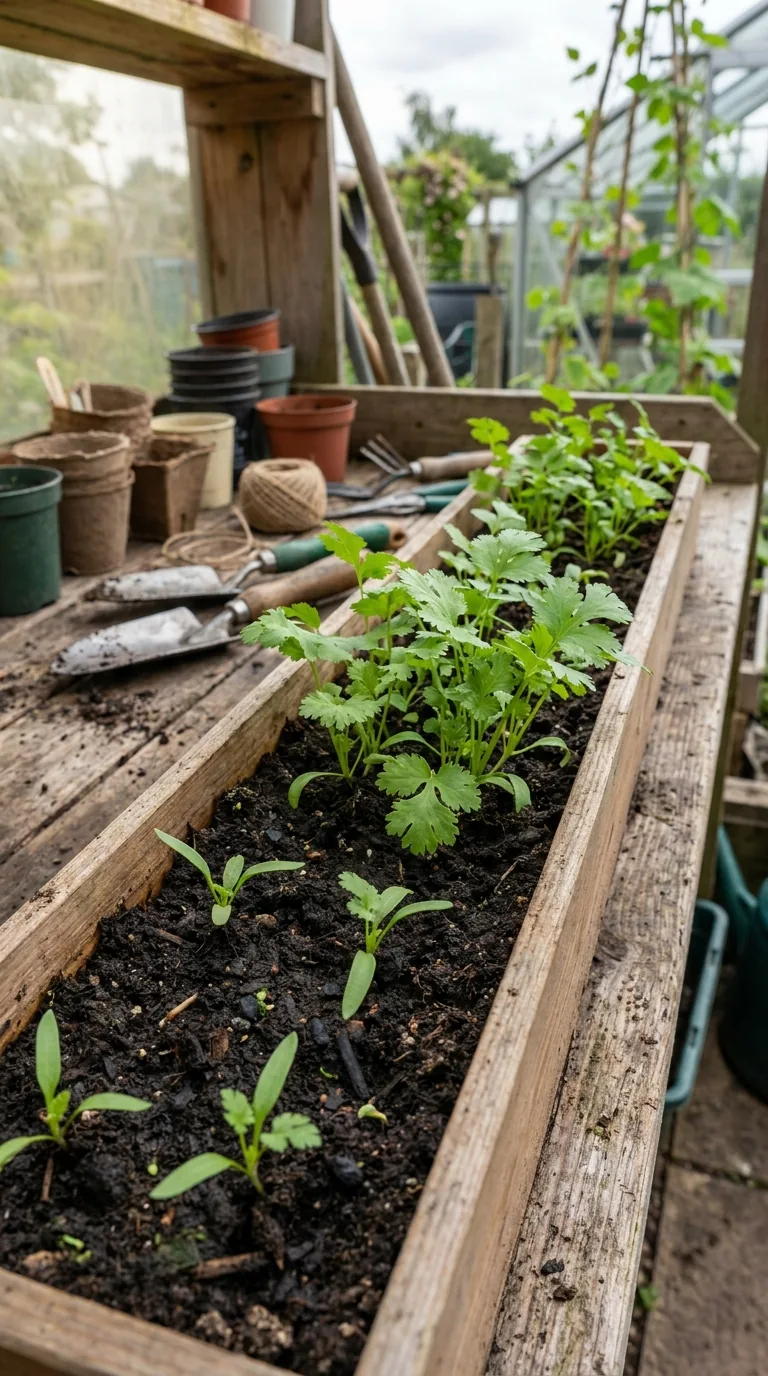
Coriander grows quickly, but it does not remain a leafy plant indefinitely. It is an annual herb that naturally flowers and sets seed. The practical goal is to obtain useful leaves before that stage, then replace the plants with a younger sowing. Choosing cooler growing periods, keeping roots evenly moist and avoiding unnecessary disturbance can lengthen the leafy phase, but no technique makes coriander permanently resistant to flowering.
A small succession of pots is usually more useful than a single large sowing. You can harvest one while the next develops, without depending on an ageing plant to supply every meal. In a British garden, spring and later summer often offer easier conditions for leafy coriander than a hot, dry midsummer window ledge. Local weather and the chosen cultivar still matter.
Decide whether you want leaves, seed or both
Leaf coriander and the dried spice come from the same species, Coriandrum sativum, but the management priorities differ. For leaves, choose a leafy or slower-bolting cultivar and harvest while stems remain soft. For seed, allow healthy plants enough space to flower and mature. A seed crop occupies its pot or bed much longer than a quick leaf harvest.
Read the packet carefully. A description such as slow bolting means a relative tendency under suitable conditions, not a guarantee that the plant will never flower. Some selections are bred mainly for seed production. Buy seed intended for sowing if you want known germination and cultivar information rather than relying on a jar of processed kitchen spice.
Plan separate small areas for the two purposes if space permits. Leave a few plants to flower while keeping younger leaf crops elsewhere. The flowers can attract visiting insects, but the presence of coriander does not guarantee pest control in surrounding vegetables. Growing it for its own useful crop is a sounder reason than expecting it to protect the whole garden.
Use sowing windows rather than one fixed date
Direct sowing outdoors is possible during the warmer part of the growing season once conditions are suitable. In many UK gardens that means starting in spring and repeating through summer, with later sowings limited by shortening days and local temperatures. Follow the packet's window and adjust for your location. A sheltered southern courtyard and an exposed northern allotment will not develop at the same pace.
For leafy harvests, make small sowings every few weeks while conditions support growth. The ideal interval depends on how much you use and how quickly the preceding pot develops. A useful decision point is when the first sowing has established its true leaves: sow the next small batch rather than waiting until the first has already begun flowering.
Avoid sowing every seed just because the calendar says the month is suitable. During a heatwave, delay, choose a cooler position or sow a modest trial. In late summer, consider whether seedlings will have enough light and warmth to become useful before winter. Protected autumn growing may extend harvests, but an unheated structure does not provide summer light levels.
Choose the final growing position early
Coriander develops a root system that is best left relatively undisturbed. Direct sowing in its final bed or container removes the need to separate tangled seedlings later. Choose fertile, reasonably moisture-retentive soil with drainage. A bed that repeatedly dries to dust is difficult to manage for leaves, while saturated ground can damage roots and prevent establishment.
Sun is useful in cooler conditions, but a little shade during the hottest part of summer can reduce stress. This does not mean placing the plants in deep shade all day. Look for a bright site with relief from intense afternoon heat. A moveable container offers flexibility, provided you shift it before the plants wilt rather than repeatedly moving a weak crop between extremes.
Avoid putting coriander in a shallow ornamental bowl that heats and dries rapidly. A reasonably deep pot gives roots more stable conditions. A container around 25cm wide and deep is a useful practical starting point for a small leafy crop; larger pots hold moisture more evenly. Keep drainage holes open and use peat-free multipurpose compost suitable for edible container plants.
Sow thinly into moist compost
Fill and water the pot before sowing so the growing medium is evenly damp. Level the surface and sow thinly according to the packet, generally with a shallow covering of compost rather than leaving a crowded layer exposed. Label the pot with the cultivar and date. Water gently so seeds stay where you placed them.
In the ground, prepare a fine enough surface for good seed contact without working wet soil into a compacted crust. Make a shallow drill, water along it if the soil is dry, sow and cover as directed. Keep the area marked while waiting for seedlings. Avoid repeatedly hoeing or raking it because germination has not appeared immediately.
Maintain moisture during germination. A surface that alternates between soaking and complete dryness is harder on emerging roots than a steady supply. If birds or pets disturb the bed, a temporary suitable cover may help, but remove or adjust it before seedlings become crowded beneath it. Check conditions under any cover because warmth can build unexpectedly.
When modules can be useful
Modules are an option where direct-sown seedlings are repeatedly lost or outdoor conditions delay establishment. Use a reasonably deep cell and sow a small number of seeds in each. Move the resulting rootball intact while the plants are still young. The purpose is to gain an establishment advantage without repeatedly potting up or teasing apart the roots.
Do not keep coriander in a tiny module until roots coil tightly and the plant is already stressed. Prepare the final site before the module crop is overdue. Water both the module and the receiving compost, make a hole of suitable size and plant at the original level. Firm gently and water around the rootball to close air gaps.
A module-raised crop may still flower quickly if it experiences heat, drought or root restriction. Transplanting is not the only influence on bolting. Compare the results with a directly sown pot in your own conditions if you want to find the easiest route. Judge usable leaf harvest and effort rather than only the first germination date.
Thin for the harvest you want
Dense sowing can give a short crop of small leaves, but it also increases competition and encourages rapid drying. For plants you want to keep for repeated harvests, thin crowded seedlings to give each room to develop. Use the packet's final spacing as a guide, adjusting for whether the crop is intended for young leaves or full seed-producing plants.
Remove seedlings carefully so you do not uproot their neighbours. In a very dense patch, snipping surplus seedlings at compost level can be easier than pulling them. Small clean thinnings can be used in the kitchen if they are suitable and have not received inappropriate treatments. Do not put them back into the same overcrowded pot merely to avoid wasting plants.
Spacing is also part of disease management. Air and light should reach lower foliage, especially in a greenhouse. A mat of leaning stems may stay damp and become difficult to inspect. Once stems are tall and flowering, adding more space cannot restore the original leafy stage, so start the next crop while the current one is still useful.
Manage heat before the plant is stressed
Hot weather and drying roots encourage rapid development towards flowering. Place summer pots where they receive useful light without baking against glass or paving all afternoon. A pale outer container can reduce heating compared with a small dark pot in direct sun, but it must not trap drainage water. Keep leaves from touching hot greenhouse glass.
Ventilate protected structures during warm weather. A thermometer near the plants is more informative than an outdoor forecast alone. If a greenhouse regularly overheats, a sheltered outdoor location or suitable shading may produce better leafy coriander. Avoid responding to heat by putting the pot in a dark room, where weak stems create a different problem.
If a flower stem appears, you can remove it and continue picking any acceptable leaves, but do not expect this to reset the plant's life cycle. Fine, feathery upper leaves and rapidly elongating central stems signal a changing growth stage. Decide whether to keep those plants for flowers and seed or replace them with the younger sowing you prepared earlier.
Water and feed with restraint
Check compost below the surface and water before the rootball becomes severely dry. Apply water to the growing medium and allow it to drain. A shallow sprinkle that wets only the top centimetre is not enough for a developed pot. Equally, leaving it continuously in a full saucer excludes air from the roots and is not a reliable way to prevent bolting.
During hot spells, inspect containers more often. Wind and plant size can matter as much as temperature. A full pot may need attention when a newly sown one remains moist. If you cannot water reliably, grow fewer pots in larger containers and choose a less exposed position. A large, repeatedly wilted crop is often less useful than a small, consistently managed one.
Fresh compost generally supplies initial nutrition. For a short leafy crop, extra fertiliser may not be necessary. If repeated picking continues over a longer period and healthy roots are using the available nutrients, a modest balanced feed at the label rate can help. Feeding cannot reverse flowering or compensate for poor moisture management. Avoid adding concentrated fertiliser to a dry or damaged rootball.
Harvest leaves without exhausting young plants
Wait until the seedlings have enough leaves and roots to continue growing after picking. Take a few outer leafy stems rather than pulling out the whole crown. Use scissors to avoid tugging the roots and leave the central growing area intact. Harvest lightly at first, increasing only as the plants produce new growth.
A closely sown pot can instead be cut as a one-off young-leaf crop, then resown. This is a different method from maintaining widely spaced plants for repeated picking. Decide which system suits your cooking and container space. Trying to combine the heaviest possible cut with indefinite regrowth usually leads to disappointment.
Pick shortly before use for the freshest flavour. Rinse as needed, dry gently and refrigerate surplus for a short period using suitable food-storage practices. Freezing chopped leaves in small portions is useful for cooked dishes, although the texture will not match a fresh garnish. Avoid claiming that a particular storage method preserves every aspect of fresh flavour unchanged.
Allow seed to mature deliberately
Choose healthy plants for a seed crop and stop harvesting them heavily. Provide room for branching stems, and stake gently if the position is exposed. White to pinkish flowers are followed by developing green fruits. Wait for the seed heads to mature and dry rather than cutting all of them while still soft and green if your aim is the dried spice.
Harvest when the heads are turning dry and brown but before the whole crop scatters. Cut into a paper bag or onto a tray and finish drying in a dry, airy place. Separate the seeds from plant debris once fully dry and store in a labelled airtight container. Any material showing mould should not be used as food.
Seed saved from a garden plant may not give identical results if different varieties have cross-pollinated. Record which plants you used and compare the next generation. Keep saved sowing seed cool and dry and test a small amount if its age is uncertain. Do not rely on one untested batch for the entire next season's crop.
Diagnose disappointing coriander
Sparse germination may reflect old seed, unsuitable moisture, excessive depth or unfavourable temperatures. Check the packet and your sowing conditions before making a stronger fertiliser application. A few weak seedlings cannot use the nutrients intended for a full pot, and additional feed does not make missing seeds germinate.
Chewed seedlings may indicate slugs or snails, especially after damp nights. Aphids can gather on tender growth. Inspect the plant and compost surface before choosing a response. Hand removal and better monitoring may be enough for small crops; use any authorised product only according to its edible-crop label and current instructions.
Yellowing with persistently wet compost suggests a different investigation from yellowing in a light, dry pot. Check roots, drainage and recent weather. If the whole crop is already flowering, replacement may be the most efficient step. Learn from the sowing date and position rather than interpreting every early flower as a failure of personal technique.
A dependable system uses small sowings, minimal root disturbance and a site that avoids the worst summer heat. Keep dates and simple observations so that next year's schedule reflects your garden. For another leafy herb with slower establishment and a different harvest pattern, growing parsley in containers explains why patience during germination and a deeper pot are useful.

