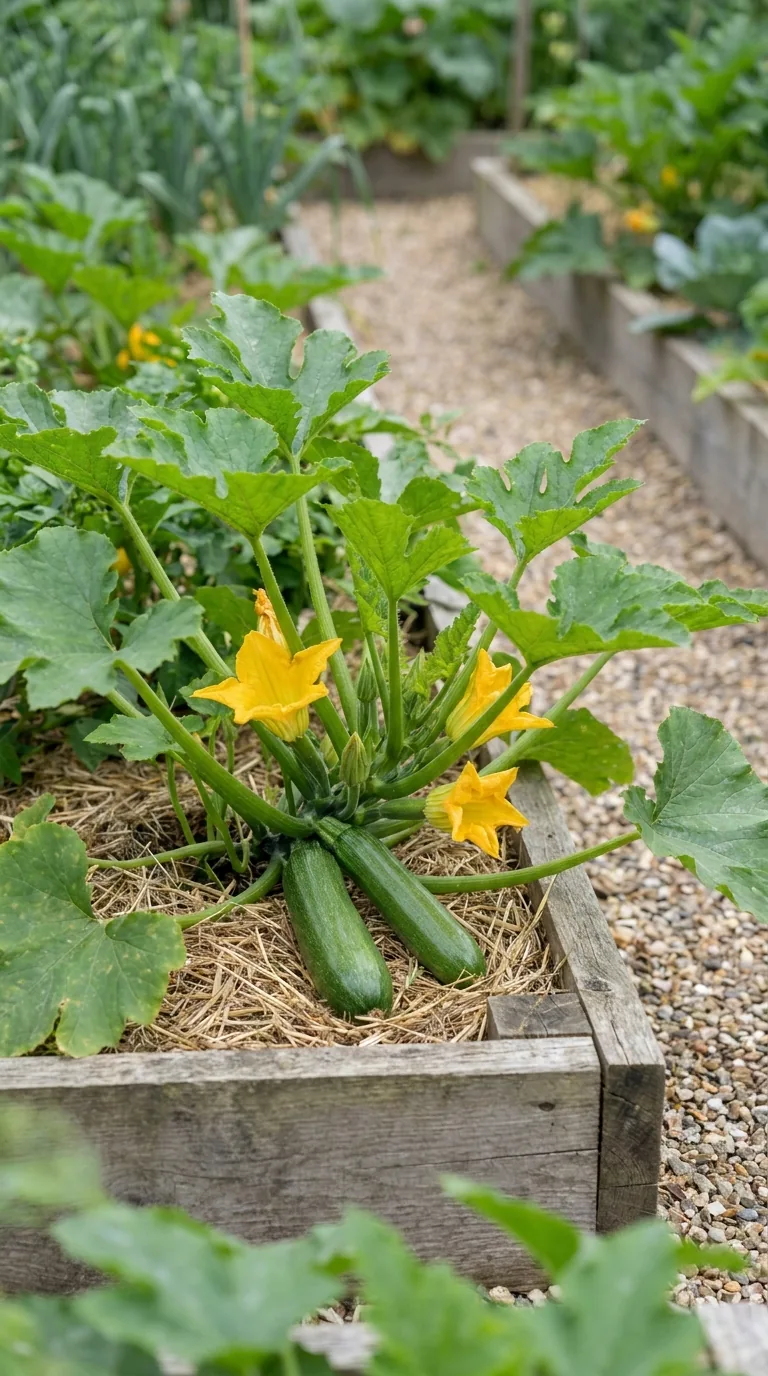
A courgette plant starts as a small seedling and can become one of the broadest plants in a summer vegetable patch. Give it warmth, room and steady moisture, and it can supply repeated pickings over several weeks. The common beginner's problem is planting too many close together, then discovering that the leaves hide fruit and make watering awkward.
Start with one or two plants if household demand is modest. Courgettes are tender and cannot be rushed through a cold UK spring. They also need attention during harvest: a small fruit left under a leaf can become a large marrow surprisingly quickly. A realistic plan includes both growing space and the time to pick regularly.
Choose a variety suited to the space
Green cylindrical courgettes are familiar, but yellow, striped and round forms are also available. Fruit colour affects how easily you spot the crop among the leaves; yellow fruit can be useful for someone who repeatedly overlooks green courgettes. Round types are often harvested young for a different kitchen use rather than allowed to become very large.
Most courgettes form a broad bush, although growth habit varies. A description such as compact means compact compared with other courgettes, not suitable for any small window box. Read the mature spread and container advice. Some cultivars can be trained with support, but a standard sprawling bush should not automatically be treated as a climbing plant.
If you buy a young plant, look for firm, healthy growth with enough roots to hold the compost together, but not a badly congested mass. Check the growing point and leaf undersides. A large flowering plant in a tiny dry pot may need more careful establishment than a smaller vigorous seedling.
Plan sowing around frost-safe planting
Indoor sowing in April or May is a practical approach for many UK gardens. Courgettes develop quickly, so starting them very early can produce large plants before the weather allows them outdoors. A bright, sheltered growing space is more useful than a head start followed by weeks of root restriction.
Direct sowing outdoors is possible in late May or early June once the soil is warm, with local adjustments. Cool northern or exposed gardens may benefit from raising plants under cover. In a mild sheltered garden, direct sowing can avoid transplant disturbance. Check the packet and forecast rather than treating the earliest date as an obligation.
| Stage | Typical approach | Reason to delay |
|---|---|---|
| Indoor sowing | April to May in warmth and good light | No room to keep fast-growing seedlings healthy |
| Hardening off | Gradual exposure before planting | Cold winds, strong sun or chilly nights |
| Outdoor planting | After frost risk, with warm soil | Forecast frost or persistently cold wet conditions |
Sow individually and protect the roots
Fill small pots with moist peat-free compost and sow one seed in each, generally about 2.5cm deep unless the packet says otherwise. Keep the pots warm without leaving them standing in water. Once seedlings appear, provide strong light and remove covers that trap excessive humidity. Label the variety and sowing date immediately.
Handle seedlings by a leaf or the rootball rather than gripping the stem. The large seed leaves are followed by the first true leaves, and growth can accelerate rapidly. Pot on if roots fill the container before outdoor planting becomes possible. Avoid breaking the roots apart when transplanting; a carefully watered, intact rootball settles more easily.
Sow only a modest spare allowance. Two healthy plants may provide more courgettes than a household expects in a favourable summer, while ten seedlings create a space problem. If you grow different varieties, keep labels visible so you can compare fruiting and plant spread rather than confusing the results.
Prepare a generous planting area
Choose a sunny position with fertile, moisture-retentive but well-drained soil. Incorporate well-rotted organic matter during preparation, removing perennial weeds. Do not put the plant in the middle of a narrow path simply because the seedling fits there now. Allow room for mature leaves, access for picking and enough space to direct water to the roots.
Space ordinary bush plants at least about 90cm apart, following the cultivar where it needs more. A plant beside the edge of a raised bed may spread beyond it, which is useful only if the neighbouring path remains usable. Consider where the shadow will fall on lower-growing salad crops.
For containers, use one plant in a substantial pot, commonly at least 45cm across, with good drainage and enough compost to buffer changes in moisture. Small pots demand frequent watering and can restrict the plant. Place a large container before filling and make sure its base does not trap water against a flat surface.
Harden off and plant carefully
Over roughly one to two weeks, expose indoor-raised plants gradually to outdoor conditions. Begin in a sheltered spot in gentle weather and increase time outside. Bring plants under cover on cold nights. Hardening off reduces transplant shock but cannot protect a tender courgette from frost.
Water the pot before planting and prepare a hole that accommodates the rootball without forcing it. Ease out the plant, keep the roots intact and set it at approximately its original growing depth. Firm gently and water thoroughly. A shallow watering hollow around the root area can help direct water, provided it does not create a permanently saturated pocket around the crown.
Protect young plants from slugs and inspect after dark or early in the morning if damage appears. A missing leaf on a tiny seedling is more consequential than a few holes on a large established plant. Check protection frequently rather than assuming one barrier or collar guarantees success.
Water steadily as the canopy expands
Courgettes have a large leaf area and need a reliable moisture supply when actively growing and cropping. Check the soil below the surface, especially in containers and during windy weather. A shower may wet the upper leaves while leaving compost beneath them relatively dry. Water the root area rather than relying on rainfall caught by foliage.
When water is needed, apply it slowly enough to soak into the soil. Do not pour a rapid stream that runs away down the path. Containers may need daily checking in summer, but watering should still depend on the actual compost. If it remains saturated, investigate drainage instead of adding more water because the leaves appear limp.
Mulch established bed-grown plants to reduce evaporation and weed competition, leaving space around the crown. Water dry soil before applying mulch rather than sealing a dry surface beneath a thick layer. A mulch changes how often you need to check; it does not remove the need to inspect moisture.
Feed in proportion to the growing conditions
A plant in well-prepared soil and a plant in a container do not have identical nutrient supplies. Container compost contains an initial reserve that eventually becomes depleted. During cropping, use a suitable liquid feed at the manufacturer's recommended dilution and frequency. A high-potassium vegetable or tomato feed is commonly used for fruiting crops.
Do not increase concentration to compensate for poor weather or missing fruit. Waterlogged roots, cool temperatures and inadequate pollination are not corrected by strong fertiliser. If leaves yellow, examine whether the change affects older leaves, the entire plant or just one damaged leaf. Match any response to the likely cause.
Understand male and female flowers
A female courgette flower has a small immature fruit immediately behind it. A male flower has a more slender stalk without that swelling. Both have a role in pollinated varieties. Plants often produce male flowers before female flowers, so an early run of flowers without courgettes is not necessarily a sign that you bought a useless plant.
Bees and other visiting insects can move pollen between the flowers. Poor weather can reduce visits and interfere with fruit development. Flowers are short-lived, so observe them in the morning when open. Some cultivars can set fruit without pollination under suitable conditions, but do not assume every courgette behaves this way.
If a tiny fruit yellows and shrivels, inadequate pollination is one possibility; moisture stress and other adverse conditions also deserve attention. Where flowers are present simultaneously and insect activity is limited, you can transfer fresh pollen from a male flower to the centre of a female flower using a small clean brush. This cannot rescue an already rotting fruit.
Keep the crop accessible
As the plant expands, lift leaves gently to look for hidden fruit without snapping their hollow stalks. Wear gloves if the rough foliage irritates your skin. Remove badly damaged or decaying leaves where they obstruct inspection, but avoid stripping off large amounts of healthy foliage simply to make the plant look tidy.
Support is optional for many bush varieties. If using a support for a suitable cultivar, install it early, keep ties loose and check the developing stem. Courgettes do not attach like peas, and forcing a brittle mature stem upright can split it. A ground-grown bush with enough room may be easier to manage than a poorly supported vertical experiment.
Powdery mildew and other warning signs
Powdery mildew often appears as a pale powdery coating on leaves, particularly later in the season. It differs from the stable silver markings that some courgette varieties naturally display. Look at how the marking develops, whether it rubs like powder and whether other symptoms are appearing before making a diagnosis.
Give plants adequate space, maintain root moisture and remove severely affected dying foliage where appropriate. Late-season mildew does not automatically mean every fruit must be discarded. Evaluate fruit individually and keep the plant under observation. Do not apply a household mixture to edible crops merely because it is described as natural.
| Problem | Checks to make | Practical response |
|---|---|---|
| Small fruit shrivels | Pollination, cold weather and root moisture | Remove failed fruit and improve the conditions you can control |
| Large leaves wilt | Compost moisture and root drainage | Water only if needed; investigate saturation |
| Fruit rots at one end | Failed development and decaying flower tissue | Remove affected fruit and monitor subsequent flowers |
| White leaf coating | Powdery mildew versus natural markings | Confirm the pattern before choosing a response |
Harvest while the courgettes are useful
Pick cylindrical courgettes while young and tender, often around 10–15cm long, adjusting for the variety and your kitchen preference. Round types are picked by their own size guidance. Use a knife or secateurs for a clean cut and support the fruit as you work. Twisting hard can tear the stem or damage the plant.
Check every few days in productive weather. Regular harvesting prevents the plant becoming occupied by several oversized fruits and gives you better eating quality. A large marrow is not automatically a failed crop, but allowing every fruit to grow large changes both yield pattern and cooking options.
Exceptionally bitter courgettes should not be eaten. Discard bitter fruit rather than trying to correct the flavour by cooking it. Use reputable seed and avoid assuming saved seed will reproduce the parent accurately, especially where related cucurbits grew nearby. Normal appearance alone does not guarantee that an unusually bitter fruit is suitable to eat.
A manageable two-plant plan
Put two plants far enough apart that their mature leaf canopies are not crushed together, and keep a clear approach for watering. Choose contrasting fruit colours if that helps you find the harvest. Note the first female flower, first successful fruit and any week when plants dried out. Those records help distinguish a seasonal setback from a persistent problem with the position.
If you want a crop that occupies a different part of the gardening year, read how to grow onions in the UK. Consider the beds as a sequence of crops rather than filling every available space with more courgette seedlings than you can manage.
At the end of cropping, remove spent growth and review whether the location supplied enough sunlight and access. Clean cutting tools and reusable containers. A plant that was difficult to reach often loses fruit simply because picking becomes inconvenient, so improving the layout can be as valuable next year as changing the variety or adding more fertiliser.
If leaves spread into a path, redirect access rather than repeatedly folding them back onto the crown. Bent leaf stalks can snap, and a congested centre becomes harder to inspect. The best correction may be a wider planting position next season.

