Poor drainage is a symptom with several possible causes. Water may be trapped by compacted soil, a dense subsoil layer, a high water table, a hollow in the surface or runoff arriving from elsewhere. Those situations need different responses. Before buying grit, digging a trench or building raised beds, find out where the water comes from, how long it remains and whether there is a safe place for it to go.
A garden that puddles briefly after an exceptional downpour is different from one with saturated roots for weeks. The second situation is more likely to harm unsuitable plants because water displaces air in the rooting zone. Leaf yellowing and wilting can follow, but the symptoms are not unique to drainage problems. Inspect the soil and the site rather than diagnosing from leaves alone.
Map the water before disturbing the ground
After rain, photograph the wet areas from a few fixed positions. Note when rain stopped, whether water is standing on the surface and how the pattern changes over the following day or days. Mark nearby roofs, downpipes, paths, walls and higher ground. If water flows across the surface during rain, its route may identify a problem that is invisible once the weather clears.
Repeat observations under different conditions. A dry summer followed by one intense storm can create a different pattern from a wet winter. Do not assume a single photograph represents the whole year. Record whether the wettest area coincides with a former vehicle route, a buried path or a low point. These clues help decide whether the problem is local compaction, surface shape or the wider site.
Stay safe while observing. Do not enter deep or contaminated floodwater, inspect unstable banks or lift drain covers without appropriate knowledge. If overflowing drains or sewage are suspected, contact the responsible service and obtain suitable advice. Contaminated flooding is a separate issue from ordinary clean rainwater puddling, especially where edible crops are involved.
Use a simple diagnostic sequence
| Observation | Likely question to investigate | Useful first response |
|---|---|---|
| Water arrives from a downpipe | Is roof water being discharged incorrectly? | Check the drainage arrangement with appropriate help |
| Only a busy footpath stays wet | Has traffic compacted the surface? | Reduce traffic and assess the soil when workable |
| A whole low area remains saturated | Is the water table or site level limiting drainage? | Seek a wider site assessment before excavating |
| New beds flood after paving work | Has runoff been concentrated? | Review how the new surfaces handle rainfall |
This sequence is a starting point, not a remote diagnosis. More than one cause may operate together. A compacted bed may also sit below a patio that directs water onto it. Fixing only the soil surface may improve infiltration temporarily while leaving the larger water load unchanged. Work from the source and destination of water towards the bed, rather than treating the planting area in isolation.
Distinguish soil texture from compaction
Clay-rich soil often drains more slowly than sandy ground, but clay is not automatically damaged soil. Compaction compresses pore spaces and can affect several textures. A worn access strip may need a traffic solution, while a naturally dense profile may require a different planting and layout strategy. Examine soil only when it is safe and sufficiently workable; digging saturated ground can worsen the problem you are trying to understand.
A small inspection hole can reveal texture changes, rubble or an abrupt dense layer, but do not dig blindly where services may be present. Establish utility routes first, and keep holes protected from children and pets. Water entering a hole may indicate local saturation, but an informal garden observation is not equivalent to a professionally designed infiltration test for a soakaway or construction project.
If you find a compacted layer, assess how extensive and deep it is before loosening it. Shallow surface damage is different from a machine-compacted subsoil. Breaking one layer without considering what lies underneath may simply move the point where water collects. Where heavy machinery or building work caused the damage, a competent soil or landscape assessment can prevent expensive repeated trial and error.
Stop adding avoidable runoff
Check gutters, downpipes and visible drainage arrangements. A blocked gutter can concentrate large amounts of roof water into one bed. Repairing that defect may be more effective than replacing the plants repeatedly. Do not reroute a downpipe casually into a border or onto neighbouring land. Roof drainage forms part of the property's water management and needs a lawful, suitable destination.
Hard surfaces change where rainfall goes. A new patio can reduce the area available for infiltration and send water towards the remaining soil. Permeable surfacing may help in an appropriate design, but permeability depends on the whole construction, including the layers beneath. A decorative porous-looking top surface over an unsuitable base is not a complete drainage solution.
Water butts can store some roof runoff when there is empty capacity, but a full butt does not absorb the next storm. Plan the overflow safely and use collected water sensibly. Storage is part of managing supply and runoff, not a guarantee against flooding. Keep lids secure and follow suitable installation advice so that a useful garden feature does not create a hazard.
Protect the soil while it recovers
Keep people, barrows and machinery off saturated beds. Establish temporary alternative access if a route must remain in use. Repeated attempts to dig, rake or stamp a wet surface into shape can smear and compress it further. Wait for a workable condition before cultivation, even if that means delaying planting. The cost of a short delay may be lower than months of damaged structure.
Where appropriate, add mature organic matter as part of longer-term soil care. It can support better structure, but it is not a pump and cannot lower a high water table. Apply to a suitable, weeded surface without burying stems, and preserve access paths. Measure the layer rather than continually adding more to a persistently wet patch without reviewing the cause.
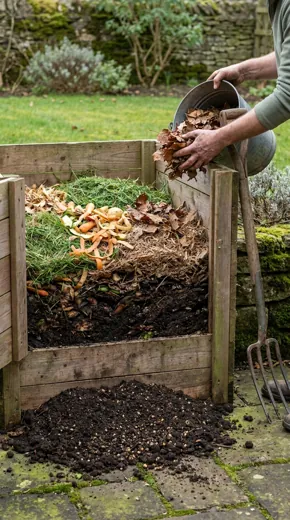
If you need a regular supply of suitable organic material, making garden compost at home can support ongoing soil improvement. Keep that role clear: compost helps care for soil, while drainage design determines where excess water can move. A useful amendment should not be sold to yourself as a guaranteed cure for every saturated site.
Consider raised beds for a defined purpose
Raised beds can lift the main rooting layer above the original surface and make it easier to work without trampling. They are especially useful where access and manageable planting areas matter. Their performance still depends on the base and the surrounding water levels. If water regularly rises high enough to saturate the fill, a frame alone will not create permanently aerated roots.
For example, a 2-metre by 1-metre bed filled 30 centimetres deep contains a nominal 600 litres of material. That is a substantial mass when wet, and the sides must retain it. Use a suitable fill rather than assuming pure loose compost will provide a lasting stable soil body. Leave practical watering space below the rim and consider how overflow will move during heavy rain.
Do not raise soil against house walls above safe existing levels or conceal air bricks and damp-proof details. A bed beside a building needs particular care. Deep retaining structures, slopes and nearby foundations may require professional design. The more a garden drainage proposal affects buildings or neighbouring property, the less suitable it is for improvised excavation based on a general gardening article.
Understand why drains need an outlet
A gravel-filled trench can hold some water temporarily, but it does not make water disappear. A land drain works only as part of a system with a suitable route and destination. Without that, the trench may become another wet channel. Before installing pipework, establish levels, soil conditions, ownership, permissions and the receiving system's capacity. Do not connect to public drainage or discharge across a boundary without appropriate authority.
A soakaway also needs suitable ground conditions and siting. It is not simply a hole full of rubble that can be placed anywhere. High groundwater, impermeable soil, nearby structures and services can make an otherwise plausible position unsuitable. Use competent advice and the applicable local requirements for property drainage. Garden planting advice cannot substitute for the necessary engineering checks.
Where professional help is sought, provide the observation record, photographs and any history of landscaping or flooding. Ask what cause the proposed system addresses, where water will go and what maintenance it requires. A clear explanation should link the design to the site's actual behaviour. A promise that one trench solves all drainage problems is a reason to ask more questions.
Use planting to fit wet conditions
Some plants tolerate moist ground better than others, but moisture-loving is not always the same as tolerant of continuous waterlogging. Check the species, light requirement, pH tolerance and seasonal conditions. A site wet only in winter and dry in summer needs plants that can cope with both. Do not choose a marginal pond plant solely because the bed was wet on one winter visit.
For established trees and large shrubs, consider root spread and mature size as well as water tolerance. Planting a thirsty tree is not a universal drainage installation and may create problems near buildings or services. Match planting to a sensible site plan. Where space is small, changing a border's plant palette can be more realistic than attempting to change the entire local water regime.
A seasonal wet feature or rain garden may be appropriate where water can be accommodated safely. Its position, overflow and planting must be planned, particularly near paths, children and buildings. The purpose is to handle a predictable source of water in a suitable location, not to disguise sewage flooding or an unexplained rise in groundwater. Get help when the situation extends beyond ordinary garden surface management.
Look after plants following waterlogging
After the ground drains, resist immediately applying heavy fertiliser to every yellow plant. Damaged roots may not be ready to use it. Assess which plants are recovering, remove clearly dead material where appropriate and maintain suitable moisture as conditions change. A plant with injured roots can later suffer drought stress even though its original problem was excessive water.
For a valuable small container plant, check blocked holes and trapped water in outer pots; this may be easier to correct than a garden-wide soil problem. For a mature tree showing decline, seek qualified assessment rather than excavating major roots to inspect them yourself. Scale the response to the plant and the potential consequences of disturbing it.
Where flooding may have involved sewage, chemicals or contaminated runoff, do not assume washing vegetables makes them safe. Seek current advice from the relevant local authority or public-health source for the specific event. Keep people and pets away from suspect material as appropriate. That decision is about contamination as well as drainage and needs information beyond the visible depth of the water.
Measure whether the chosen response helped
Continue photographing the same locations after comparable rainfall. Note water duration, access damage and plant recovery. Weather differences mean that one dry month cannot prove a permanent cure, but a repeated pattern is useful evidence. Maintain gutters, drain inlets and any installed system as instructed. A good design can still fail if its outlet becomes blocked or its surface is compacted again.
Start with the least disruptive response that addresses the cause, then reassess. Repairing a leaking downpipe, changing access or selecting suitable plants may be enough for one garden; another may need a professional drainage plan. The aim is a workable root environment and safe water movement, supported by evidence rather than a promise that every wet bed can be fixed with the same amendment.
Keep a simple maintenance drawing showing any new drainage route, inspection points and areas that must remain permeable. Store it with property records so that later fencing or landscaping does not accidentally block the solution. If a contractor performs the work, ask for the final layout and operating advice, including signs that professional inspection is needed.
Before further landscaping, walk the proposed route of water during a storm on the plan. Identify where an overflow would travel if storage filled or an inlet blocked. Keep important exits and building thresholds in view. This simple exercise can reveal a design that protects one bed while shifting the problem to a more vulnerable location. Where the answer is uncertain, resolve it before excavation or construction begins.