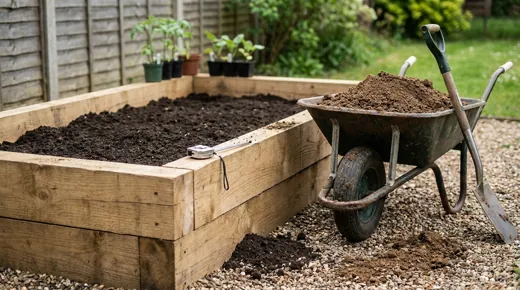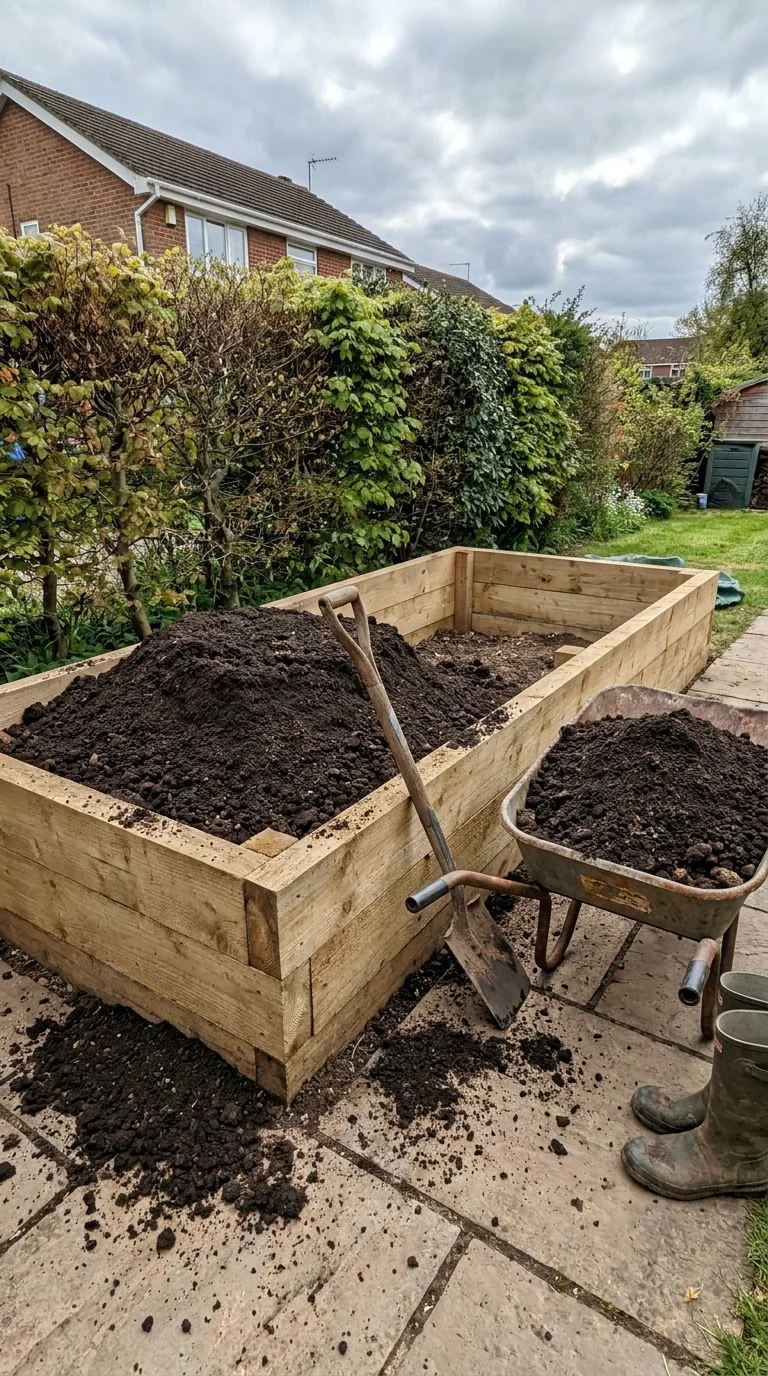
The amount of soil a raised bed needs is a volume calculation. Measure the space inside the frame, multiply length by width by the intended depth of fill, and convert the result into the units your supplier uses. The arithmetic is simple, but several practical details can change the order: board thickness, a watering margin, irregular shapes, settlement and the quantity actually contained in a bag.
Keep volume separate from weight. Litres and cubic metres describe the space occupied; kilograms and tonnes describe mass. Wet topsoil, compost and lightweight container media have different densities. A useful order estimate should state the product and volume rather than assume that every litre weighs a kilogram. This is particularly important for delivery planning and beds on structures.
Measure inside the frame
Use internal length and width, taken between the inner faces of the sides. A kit advertised as two metres long may quote its outside dimension, so check before using the catalogue number. Thick boards and corner posts reduce the fill space. Measuring a completed frame is more reliable than reconstructing the dimensions from a product title.
Decide how high the soil should finish. You may want a small margin below the top for watering and mulch. Measure from the intended base of the growing medium to that finished level. Do not automatically multiply by the full outside frame height. If the bed sits on a slope or has an uneven base, the required fill depth may vary across its footprint.
Write every measurement down with its unit. A common error is entering a depth of 30 as though it were metres when it was measured in centimetres. Convert all dimensions to the same unit before multiplying. For most garden calculations, metres are convenient because the result is directly in cubic metres and can be converted to litres easily.
| Starting measurement | Equivalent | How to convert |
|---|---|---|
| 100 centimetres | 1 metre | Divide centimetres by 100 |
| 1,000 millimetres | 1 metre | Divide millimetres by 1,000 |
| 1 cubic metre | 1,000 litres | Multiply cubic metres by 1,000 |
| 100 litres | 0.1 cubic metre | Divide litres by 1,000 |
| 1 litre | 1,000 cubic centimetres | Useful when checking small-container maths |
Use the rectangular-bed formula
For a rectangular bed, volume equals internal length multiplied by internal width multiplied by fill depth. If all three measurements are in metres, the result is cubic metres. Multiply by one thousand to obtain litres. Keep the unrounded result until the final purchasing step; rounding each dimension prematurely can create a noticeable difference for a large bed.
Consider a bed with internal dimensions of 2.4 metres by 1.2 metres and a planned fill depth of 0.3 metres. First multiply 2.4 by 1.2 to obtain a surface area of 2.88 square metres. Multiply that area by 0.3 to obtain 0.864 cubic metres. The equivalent volume is 864 litres. This is the geometric space, before any separate allowance for settlement.
If you measured in centimetres, the same calculation is 240 × 120 × 30, giving 864,000 cubic centimetres. Divide by one thousand to obtain 864 litres. Both methods agree. The metre method is usually easier to compare with bulk suppliers, while the centimetre version can help you check a small planter measured with a household tape.
Separate top-ups from first filling
A bed that is already partly full does not need its total frame volume again. Measure the average gap between the current surface and the desired finished level. Use that additional depth in the formula. For a two-metre by one-metre bed needing a five-centimetre top-up, the calculation is 2 × 1 × 0.05, or 0.1 cubic metre: 100 litres.
Check several points if the surface is uneven. A hollow at one end should not be treated as the depth across the entire bed. Level gently first where appropriate, or calculate separate sections. Avoid compacting the soil heavily to obtain a tidy measurement. The aim is a realistic estimate of missing volume, not a compressed surface that makes the order appear smaller.
Top-up material should suit the existing growing system. Repeatedly adding rich compost merely because the level has dropped can gradually change the soil’s properties. Consider whether the drop reflects ordinary settlement, decomposition of a very organic fill or soil being removed with harvests. Choose an appropriate amendment or growing mixture rather than assuming every top-up should be identical.
Calculate bag quantities by rounding up
Divide the required litres by the labelled bag volume. For the 864-litre example, nominal 50-litre bags give 864 ÷ 50 = 17.28 bags. Since you cannot normally buy a fraction of a sealed bag, round up to 18 bags. At 40 litres per bag, 864 ÷ 40 = 21.6, so 22 whole bags are required before any separate contingency.
Bag size is not a measure of suitability. A convenient 50-litre multipurpose compost is not automatically the best complete fill for a large permanent raised bed. Suitable topsoil and mature organic matter may be more appropriate, depending on the bed and crops. Decide the material first, then calculate the quantities of each component using the intended mixture.
| Labelled bag size | Exact quotient | Whole bags rounded up | Labelled total |
|---|---|---|---|
| 25 litres | 34.56 | 35 | 875 litres |
| 40 litres | 21.6 | 22 | 880 litres |
| 50 litres | 17.28 | 18 | 900 litres |
| 60 litres | 14.4 | 15 | 900 litres |
These numbers compare labelled quantities only. Handling, packing and settlement affect how materials fill a bed in practice. Check the supplier’s product information and avoid promising that a stated number of bags will produce an exact final surface after watering. Keep receipts and note the actual amount used so future top-ups can be estimated from experience with your own bed.
Understand bulk delivery descriptions
Bulk materials may be sold by cubic metre, tonne or an unspecified “bulk bag”. Those are not interchangeable. Ask for the stated volume or mass and the product specification. A large fabric bag can contain less than one cubic metre. If the supplier sells by mass, request an appropriate volume estimate for that particular material rather than applying a universal conversion.
Compare delivered quantities and quality, not just the headline price per bag. A cheaper load containing unsuitable debris is not a saving. Confirm whether the material is topsoil, finished compost, a blended planting soil or another product. Ask about its intended use, screening and any relevant quality information. The correct calculation cannot make an unsuitable product appropriate for vegetable growing.
Delivery access can determine the practical order. A supplier may leave the load at the kerb rather than carry it into the garden. Check restrictions, surface suitability and where a heavy vehicle can safely stop. Plan how the material will reach the bed without blocking entrances or damaging paths. Several smaller deliveries may be more manageable than one load you cannot move.
Allow for settlement explicitly
Freshly filled material usually settles as large air spaces close and organic components change. The amount varies with the material, moisture and how it was placed. There is no universal percentage that guarantees the final level. You can add a clearly labelled contingency for ordering, or fill to the intended level and plan a later top-up after observing the result.
For illustration, adding a ten-percent purchasing allowance to 864 litres gives 950.4 litres. That is a planning scenario, not a measured prediction of settlement. With 50-litre bags, the rounded purchase would be 20 bags, giving 1,000 labelled litres. A five-percent allowance would give 907.2 litres and round to 19 such bags. State which assumption you used.
Do not apply an allowance twice by rounding generously at several stages and then adding another unexplained surplus. Keep a short worksheet: geometric volume, selected contingency and final pack rounding. A surplus may be useful for later top-ups, but it also costs money and needs storage. Fresh organic material can settle far more than a stable mineral-based soil, so a different fill design may be the real solution.
Handle irregular shapes in sections
An L-shaped bed can be divided into two non-overlapping rectangles. Calculate each section and add the volumes. Be careful not to count the shared corner twice. Sketch the shape, label every internal measurement and mark the division clearly. This is more reliable than trying to estimate the whole area by eye.
For example, imagine an L formed from a 3 by 1 metre rectangle plus a 1 by 1 metre extension, both filled to 0.3 metres. Their areas are three and one square metres, making four square metres overall. The volume is 4 × 0.3 = 1.2 cubic metres, or 1,200 litres. If your diagram includes an overlap, subtract it before multiplying by depth.
For a circular bed, area equals pi multiplied by the radius squared. A bed with an internal diameter of 1.2 metres has a radius of 0.6 metres and an area of approximately 1.131 square metres. At 0.3 metres fill depth, it contains about 0.339 cubic metre, or 339 litres. Use the internal diameter and remember to halve it before squaring.
Tapered beds and sloping bases need care
A tapered container is not a rectangular box. Multiplying the top opening by the full depth can overestimate its capacity. Manufacturer capacity information may be more reliable, or the shape can be calculated using an appropriate geometric method. Do not treat an irregular planter as an exact rectangular bed and then describe the result as a precise quantity.
For a bed on a uniformly sloping base with a level final surface, an average depth can provide an estimate when the sides and geometry are simple. If one end needs 20 centimetres and the other 40 centimetres, the average is 30 centimetres. This works only when the depth changes evenly. Uneven hollows, steps and buried structures should be measured as separate sections.
If the bed has a designed false base or internal displacement, subtract only the volume that genuinely excludes growing medium. Do not bury random containers or waste to reduce the order without understanding drainage, stability and crop rooting. Elevated access planters should follow their specified fill capacity and load limits rather than a home-made volume-saving arrangement.
Plan weight and handling separately
Volume alone cannot establish whether a balcony, deck or roof can carry a bed. Wet material density, the frame, stored water and other loads all matter. Obtain the relevant structural or building approval before buying large quantities. A frame that fits the floor area can still impose an excessive load, particularly when soil is deep and saturated.
For ground-level handling, use manageable loads and an appropriate wheelbarrow. A nominal large bag may be awkward even if its dry contents seem light. Avoid lifting a full bag while twisting or reaching over the frame. Empty smaller portions or use suitable equipment. Plan the job around safe access rather than trying to finish an entire delivery in one strenuous session.
Store unused growing media according to supplier guidance, protected from contamination and excessive wetting where appropriate. Keep bagged materials away from drains and access routes. Label different products so that topsoil, compost and amendments are not confused during a later top-up. Accurate ordering is useful only if the materials remain suitable until they are used.
Use the calculation to improve the overall plan
Once the volume is known, review whether the proposed bed is still sensible. Reducing unnecessary depth can save a large amount of material where roots have good soil below. Splitting a wide bed may improve access without changing the growing area dramatically. The guide to planning a vegetable garden layout connects these quantities with paths, sunlight and workable crop positions.
Before ordering, check five entries: internal length, internal width, intended fill depth, product units and any stated allowance. Keep the calculation with delivery details and record actual use after filling. The result is a practical estimate with clear assumptions, which is more valuable than an apparently exact number that ignores the bed’s shape, material or final soil level.
Check a quotation against the worksheet
When a supplier offers a package of soil and compost, compare each component with the total planned volume. If the order contains 600 litres of one product and 300 litres of another, the labelled total is 900 litres, not the capacity of either package alone. Note whether delivery descriptions use loose or compacted quantities. Ask for clarification before paying if the quotation switches between tonnes, bags and cubic metres without explaining the relationship.