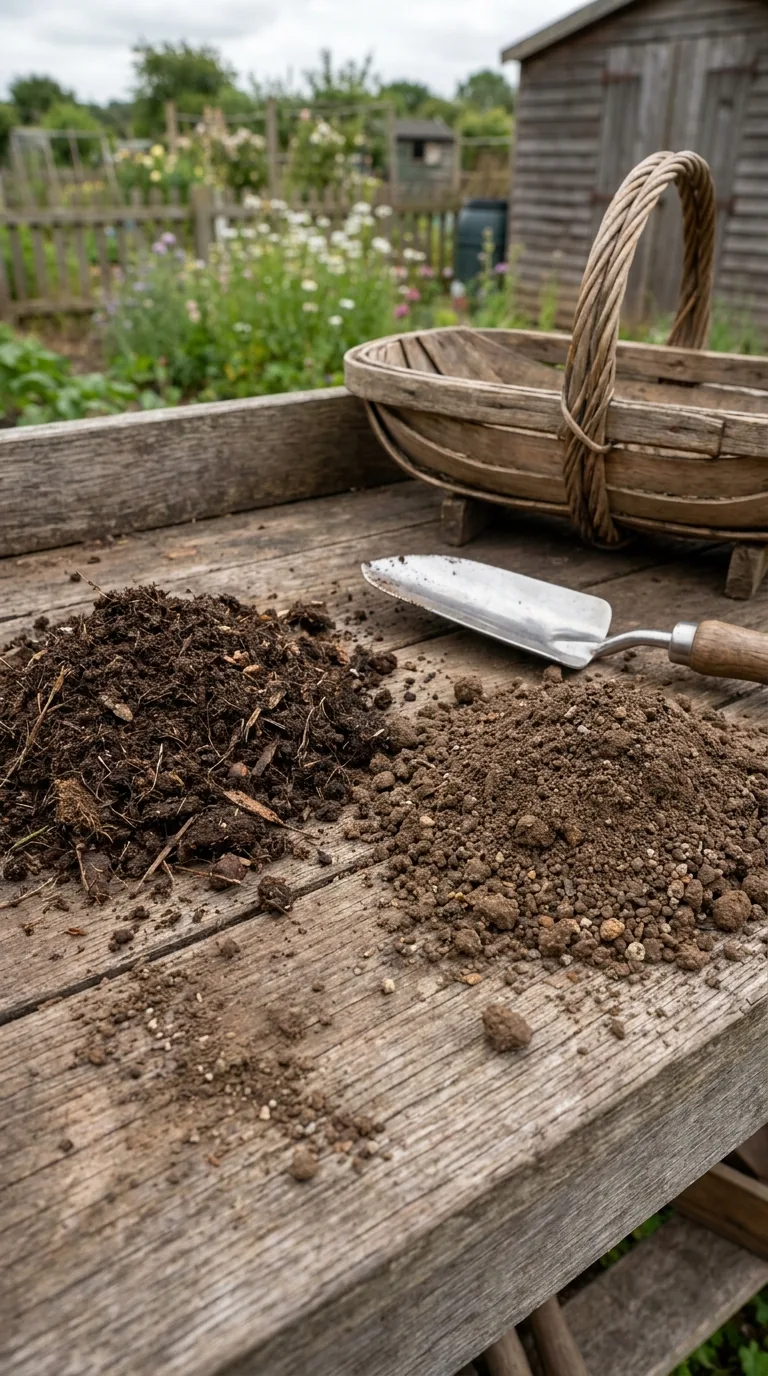
Topsoil and compost do different jobs. Topsoil provides a mineral soil body for a bed, border or lawn. Garden compost adds decomposed organic matter that can improve an existing soil. Potting compost is another product again: a growing medium formulated for plants in containers. The confusing word is compost, because it appears both on a heap of decomposed garden waste and on bags designed for seeds or patio pots.
Before buying anything, finish this sentence: I need material to fill a space, improve existing ground, or grow plants in a container. Those are different problems. A dark colour, a large bag and a gardening label do not establish that a material suits all three. Checking its intended use usually prevents more mistakes than choosing by price per bag.
What topsoil actually contains
Natural topsoil is the upper soil layer where mineral particles, organic matter, roots and organisms interact. Its mineral portion includes varying amounts of sand, silt and clay. That stable mineral body is an important reason it behaves differently from a pile of decomposed leaves. It also contains pore spaces that hold air or water. Good structure matters as much as the ingredient names: compacted topsoil can be difficult to grow in even when it contains useful nutrients.
Purchased topsoil varies. It may be screened natural soil, manufactured from specified components, or recovered material of variable origin. Screened means that larger pieces have been removed to a particular size; it does not automatically mean fertile, weed-free or appropriate for food growing. Ask what the product is, where it came from and what testing supports the supplier's description. For a large delivery, those questions matter more than whether the photograph looks rich and brown.
Topsoil is commonly useful where a garden has lost its original surface layer or where a new bed needs a substantial stable fill. It can also form part of a suitable raised-bed mixture. It is not the default choice for small seed trays or ordinary houseplant pots. In a restricted container, garden soil can become dense and difficult to manage, while the plant's roots depend entirely on the limited medium you provide.
What garden compost contributes
Garden compost is decomposed plant material. Its strongest role is as an organic soil improver or surface mulch. It is not simply a concentrated bag of every nutrient a plant might require, and its composition depends on its ingredients and maturity. A home batch made largely from leaves will differ from a commercial green-waste compost. Neither should be assumed to have an identical nutrient analysis to the other.
Organic material changes as it continues decomposing. A bed filled only with a bulky organic product may lose considerable volume and require topping up. That is an important difference when the job is to create a lasting soil profile. Adding compost to a mineral soil can be useful; assuming compost alone will remain a stable, permanent replacement for all soil can lead to sinking levels and an unsuitable rooting environment.
Use mature garden compost on beds where its variable structure is acceptable. Keep coarse, unfinished material out of fine seed drills. Check purchased soil improvers for their stated use and any application limits. If a product is called composted manure, do not treat that as identical to garden compost, a seed medium or topsoil. The noun at the end of the label is not enough: read the intended application.
Why bagged potting compost is different
Potting compost is formulated to provide a workable balance of water, air and root support in a container. Peat-free products may combine wood fibre, bark, coir, composted green material or mineral components in different proportions. Some include a starter fertiliser; some are formulated for a particular plant group. A multi-purpose mix, a seed-sowing mix and an ericaceous mix should not be treated as interchangeable merely because each comes in a similar bag.
The appropriate medium also depends on how long plants will occupy the container. A temporary summer display and a shrub intended to remain for years impose different demands. Check the product's description for long-term container use, feeding advice and storage instructions. If a bag includes loam or carries a John Innes description, verify that it explicitly says peat-free if that is your requirement. Descriptive tradition does not establish the current ingredient list.
Choose by the garden situation
| Situation | Main material decision | Reason |
|---|---|---|
| An existing border needs organic matter | Use a suitable mature soil improver | The mineral soil body already exists |
| A new raised bed needs a substantial fill | Choose suitable topsoil or a specified raised-bed mix | A stable root zone needs more than a loose surface mulch |
| A patio pot needs planting | Use a suitable peat-free container medium | Its drainage and feeding must work within a restricted volume |
There are exceptions, but the table gives a useful starting point. For example, a raised planter with a sealed base and drain holes behaves more like a very large container than a bottomless bed over open soil. Its structural loading, drainage and medium need separate thought. A bed intended for acid-loving plants also needs a different specification from a general vegetable bed. Define the plants and construction before selecting the fill.
Worked example: improving a vegetable bed
Suppose an existing bed measures 1.2 metres by 4 metres. Its area is 4.8 square metres. You want to add a 5-centimetre surface layer of mature garden compost, so convert the depth to 0.05 metres and multiply: 4.8 × 0.05 = 0.24 cubic metres. That is 240 litres. The calculation describes the loose layer volume; actual delivery, uneven surfaces and settling may affect the amount needed.
Here the bed already has soil, so ordering a deep load of topsoil merely to add organic matter would solve a different problem. Remove persistent weeds, check moisture and spread the suitable compost evenly. Keep the layer clear of established stems. If soil levels already sit close to a wall's damp-proof course or a path edge, check whether there is room for the addition. Improving a bed should not create a new building or access problem.
Worked example: filling a new raised bed
A bottomless bed measuring 2 metres by 1 metre with a planned fill depth of 0.3 metres has a nominal volume of 0.6 cubic metres, or 600 litres. That calculation is before adjusting for the actual inside dimensions, existing soil level and any planned freeboard below the rim. Record those details rather than assuming the outside timber dimensions represent the volume that needs filling.
Ask a supplier for a suitable raised-bed soil specification, rather than ordering 600 litres of an arbitrary bagged compost. A mineral topsoil component with appropriate organic improvement is often a sensible starting point. There is no universal blend ratio for every crop, soil texture and bed design. If a supplier proposes a mixture, ask what its drainage, nutrient status and pH are intended to support. Do not bury rubbish or untreated uncertainty beneath a thin decorative top layer.
Before filling, check the ground beneath. A compacted base or impermeable paved surface changes how water escapes. Raising the sides does not guarantee drainage. If the bed sits on paving, confirm that water can leave safely, the paving and structure can carry the wet load, and the medium suits that container-like situation. For deep or heavy installations on balconies and roof terraces, structural assessment is part of the design rather than a gardening afterthought.
Worked example: buying medium for containers
For four planters each holding approximately 25 litres at the intended fill level, you need around 100 litres of medium, less the volume displaced by existing rootballs. The precise pot shape matters: a tapered pot's capacity is not simply its rim area multiplied by its height. Use its stated capacity or measure sensibly. Leave enough watering space below the rim so that water does not immediately run off the surface.
Choose a medium suited to the plants rather than using leftover builders' soil because it is free. Do not create a thick layer of gravel in the base and assume it compensates for a dense, unsuitable mix. Keep drainage holes clear and select the root-zone medium properly. A small crock may stop material washing through an unusually large opening, but it is not a substitute for drainage capacity throughout the container.
Inspect and question bulk deliveries
Request a current sample or inspect the proposed material before ordering a large quantity. Look for obvious glass, sharp fragments, excessive rubble, persistent weed roots or an unpleasant contamination smell. A visual inspection cannot establish chemical safety, so ask for relevant test information where origin or use makes that necessary. Material reclaimed from an unknown industrial site needs more than a reassuring colour description.
Agree the quantity unit. A tonne describes mass; a cubic metre describes volume. Wet soil weighs more than dry soil, and loose densities vary, so a tonne is not automatically a cubic metre. If the supplier quotes bags, ask for their filled volume or mass and what that means for your calculation. Also check access: a bulk bag delivered beside the road still has to reach the bed, potentially through a narrow gate and across soft ground.
Plan unloading before the vehicle arrives. Protect surfaces appropriately, avoid blocking drains and keep a safe pedestrian route. Moving small barrow loads is often more realistic than trying to shift a heavy bulk bag after delivery. Do not store a deep pile against a fence that was not designed to retain soil. If the delivery differs materially from the agreed sample or description, document the concern before spreading it throughout the garden.
Avoid buying your way around a diagnosis
Yellow leaves do not prove that a bed needs topsoil. Poor drainage does not prove that it needs more compost. Plants may be struggling because of shade, compaction, waterlogging, unsuitable pH or damaged roots. Adding material without identifying the limiting condition can increase levels without improving growth. Start by examining the existing rooting depth, moisture and structure. For a difficult site, a soil test can be cheaper than correcting a misplaced bulk delivery.
Where plant suitability is uncertain, test the existing garden soil pH before selecting an amendment or specialist fill. Texture and acidity are separate properties: a gritty soil is not automatically the right acidity for every drought-tolerant plant, and a clay soil is not automatically alkaline. Choose based on measurements and the intended planting rather than appearance alone.
Store leftovers for their intended next job
Keep bagged potting medium closed and protected according to the manufacturer. A torn bag left open in wet weather may no longer behave like the product you originally bought. Label opened bags so that a specialist medium is not accidentally used for the wrong plants. Avoid stockpiling years of unused product when a fresh supply can be obtained for the next season.
Store bulk topsoil on a suitable protected area and cover it when needed to reduce excessive wetting and weed establishment. Do not compact it by repeatedly driving over the pile. Mature garden compost can be held separately from fresh waste until a bed becomes available. If several materials are present at once, label them. A written order and a simple photograph of the original bags make future decisions easier than trying to identify three similar brown piles from memory.
A short buying checklist
Write down the job, plant requirements, measured volume and delivery access. Check the material's intended use, origin and relevant test information. Confirm whether the quotation is by mass or volume. Establish how the material will drain in the finished bed or container, and how it will be stored until needed. With those decisions made, compare like with like. The cheapest bag is useful only if it performs the job you actually need.
After planting, check the result through a wet period and a dry period. Note whether the surface crusts, water remains trapped or levels settle unexpectedly. These observations help distinguish a material problem from the ordinary establishment needs of new plants. Retain the supplier details and product label until the bed or container is performing as expected, particularly after a substantial purchase.
When comparing quotations, use a small written specification rather than a product nickname. State the intended plants, approximate volume, access limits and any known soil concerns. Ask suppliers to identify substitutions before delivery. This makes it easier to compare offers fairly and reduces the chance that a cheaper alternative arrives with a different use or composition from the material you expected.

